
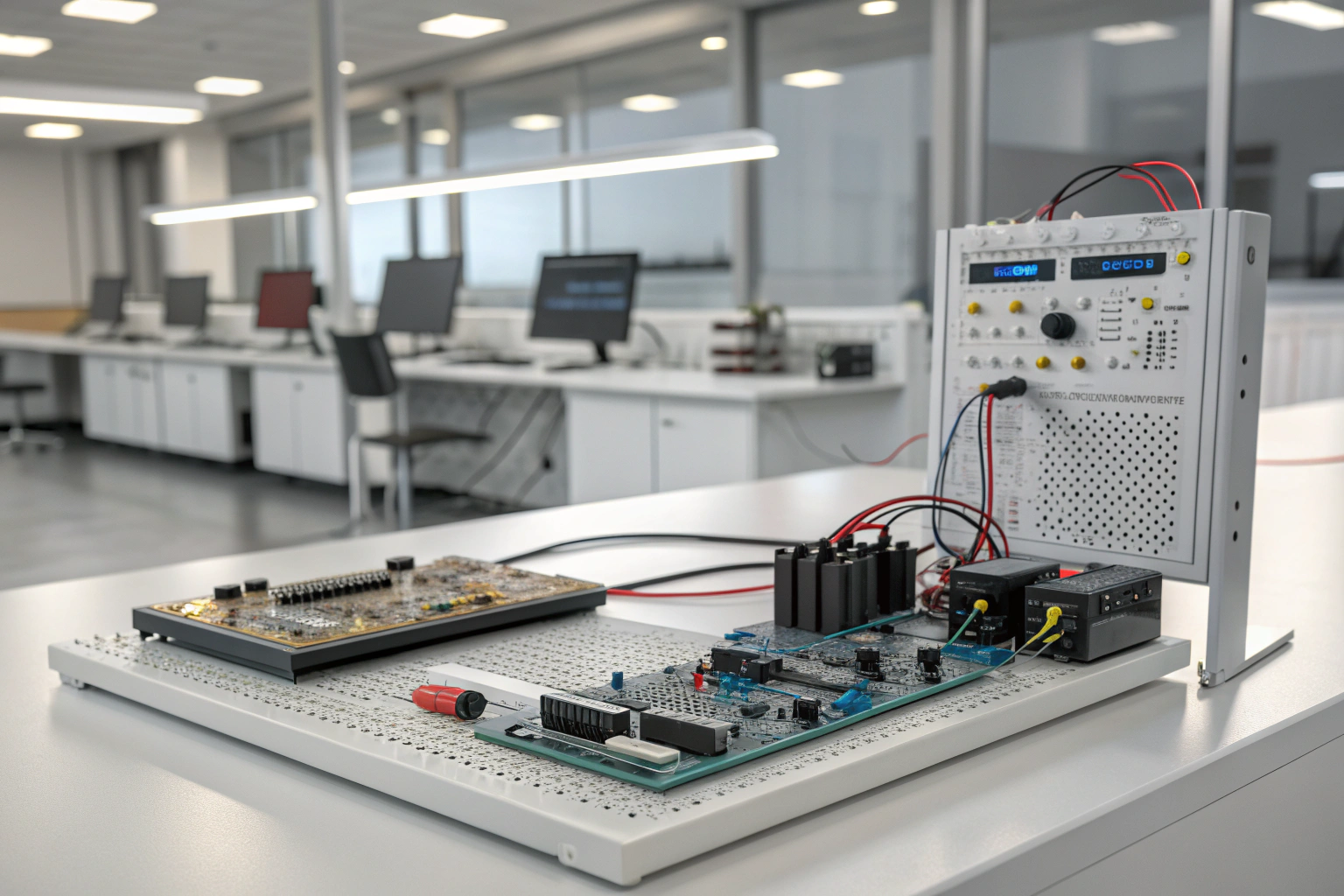
Driverless vehicle firmware is the foundational software embedded directly into a car’s hardware components, like sensors, cameras, and braking systems. It acts as the operating system for each part, translating data from the physical world into digital commands the vehicle’s main computer can understand. Proper firmware is critical for safety and performance, as it controls fundamental actions like steering adjustments and object detection, a primary concern for consumers and regulators alike.
Key Benefits at a Glance
- Enhanced Safety: Enables faster, more reliable communication between sensors and the central computer for quicker emergency braking and obstacle avoidance.
- Improved Performance: Delivers a smoother ride, more efficient route planning, and better energy management by optimizing how hardware components function.
- Effortless Updates: Allows for over-the-air (OTA) updates, which fix bugs, patch security vulnerabilities, and add new features without a trip to the dealership.
- Greater Reliability: Reduces the risk of system failures or glitches by ensuring all electronic components work together seamlessly and predictably.
- Future-Proof Technology: Well-managed firmware allows vehicles to adapt and improve over time, integrating new autonomous driving capabilities as they are developed.
Purpose of this guide
This guide is for current and prospective owners of autonomous or semi-autonomous vehicles, as well as anyone curious about the core technology that makes self-driving possible. It demystifies the complex topic of driverless vehicle firmware, explaining its role in ensuring safety, reliability, and performance. By reading this, you will understand why firmware updates are crucial, how they differ from regular software updates, and how to ensure your vehicle’s systems remain secure and effective for long-term peace of mind.
Introduction
As someone who has spent over a decade designing and implementing driverless vehicle firmware, I've witnessed firsthand how this invisible foundation transforms metal and silicon into intelligent, autonomous systems. Driverless Vehicle Firmware serves as the critical brain that orchestrates every decision, from interpreting sensor data to executing split-second maneuvers that keep passengers safe.
The complexity of autonomous vehicles extends far beyond what meets the eye. While consumers see sleek exteriors and intuitive interfaces, the real magic happens within layers of sophisticated firmware development that must operate flawlessly under extreme conditions. This firmware doesn't just enable driverless vehicle operations – it defines the very essence of vehicular intelligence.
Throughout my career developing embedded systems for major automotive manufacturers, I've learned that successful autonomous vehicle firmware requires a unique blend of real-time processing expertise, safety-critical design principles, and deep understanding of vehicular automation requirements. The stakes couldn't be higher: a single firmware bug can mean the difference between a successful journey and a catastrophic failure.
In this comprehensive guide, I'll share the architectural insights, security frameworks, and development methodologies that have proven essential in creating robust autonomous vehicle systems. We'll explore how modern self-driving car technology relies on carefully orchestrated firmware layers, examine the critical challenges of real-time processing, and look ahead to emerging standards that will shape the future of autonomous transportation.
Beyond functional safety and sensor fusion, autonomous firmware must also optimize power consumption to avoid issues like parasitic draw in automotive systems, ensuring the vehicle remains operational even during extended idle periods.
The architecture behind autonomous vehicle firmware
Modern Driverless Vehicle Firmware follows a sophisticated layered architecture that I've refined through years of hands-on development experience. This approach isn't just theoretical – it's the practical foundation that enables embedded system components to work seamlessly together in the demanding environment of autonomous vehicles.
The architecture I've implemented across multiple projects centers on four distinct layers, each with specific responsibilities and performance requirements. The software layers must interact efficiently while maintaining the isolation necessary for safety-critical operations. This layered approach enables computer hardware integration that can scale from basic driver assistance to full autonomy.
| Layer | Function | Key Components | Processing Requirements |
|---|---|---|---|
| Application Layer | High-level decision making | Path planning, behavior control | Low latency |
| Middleware Layer | Data abstraction and routing | Message queues, data fusion | Real-time |
| Hardware Abstraction Layer | Device interface management | Driver APIs, sensor interfaces | Deterministic |
| Hardware Layer | Physical components | ECUs, sensors, actuators | Hardware-dependent |
“The top 95% of automotive electronic control unit (ECU) suppliers leverage Siemens software.”
— Siemens, 2024
Source link
The operating system selection proves crucial at the middleware layer, where I've found that real-time operating systems (RTOS) provide the deterministic behavior essential for safety-critical functions. Each layer communicates through well-defined interfaces that enable independent development and testing while maintaining system coherence.
- Firmware architecture follows a strict layered approach for maintainability
- Each layer has specific timing and processing requirements
- Hardware abstraction enables portability across different vehicle platforms
- Integration between layers requires careful interface design
The computational backbone of modern autonomous systems is increasingly based on specialized automotive SoCs that integrate CPU clusters, AI accelerators, and safety islands into a single silicon package.
Core components and their interactions
The heart of any Driverless Vehicle Firmware system lies in its core components, each designed to handle specific aspects of autonomous operation. Through my experience developing these systems, I've learned that successful sensor fusion requires more than just combining data streams – it demands sophisticated algorithms that can resolve conflicts and maintain consistency across multiple sensor modalities.
The embedded system architecture I've implemented centers around six primary components that work in concert to enable autonomous functionality. Each component runs on dedicated microcontroller resources, ensuring that critical functions maintain their real-time performance even under heavy computational loads. The Advanced driver-assistance system integration requires careful attention to timing and data flow between components.
- Sensor Interface Module – Manages data acquisition from cameras, LiDAR, radar, and IMU sensors
- Data Fusion Engine – Combines multi-sensor data into coherent environmental model
- Perception Pipeline – Processes sensor data to identify objects, lanes, and obstacles
- Decision Engine – Evaluates scenarios and determines appropriate vehicle actions
- Control Interface – Translates decisions into actuator commands for steering, braking, acceleration
- Safety Monitor – Continuously validates system state and triggers failsafe mechanisms
The interaction between these components follows strict protocols I've developed to ensure data consistency and timing predictability. The sensor interface module operates at the highest priority, feeding data to the fusion engine which maintains a rolling buffer of environmental state information. This architecture has proven robust across various vehicle platforms and operating conditions.
See-think-do approach in autonomous vehicle firmware
The cognitive framework I've implemented in Driverless Vehicle Firmware mirrors human driving behavior through a structured "See-Think-Do" approach. This methodology has guided my architectural decisions across multiple autonomous vehicle projects, providing a clear conceptual model that translates effectively into software implementation.
The "See" phase relies heavily on sensor fusion algorithms that I've optimized for real-time performance. Multiple sensor streams converge into a unified perception pipeline that creates a comprehensive environmental model. The artificial intelligence components in the "Think" phase process this fused data through machine learning models that have been trained on millions of driving scenarios.
“NVIDIA DRIVE Hyperion is a validated, production-ready vehicle platform that accelerates autonomous driving development from Level 2++ to Level-4.”
— NVIDIA, 2024
Source link
The "Do" phase translates high-level decisions into precise actuator commands through control algorithms I've tuned for smooth, predictable vehicle behavior. This three-phase approach has consistently delivered more maintainable and debuggable firmware compared to monolithic architectures I've worked with in the past.
From sensors to decisions: the data flow
Understanding the complete data journey through Driverless Vehicle Firmware has been crucial to optimizing performance in my autonomous vehicle projects. The transformation from raw sensor readings to actionable vehicle commands involves multiple processing stages, each with specific timing and accuracy requirements.
The sensor fusion algorithms I've developed must handle data streams arriving at different rates and with varying latencies. Camera data arrives at 30-60 Hz, while LiDAR typically operates at 10-20 Hz, and radar sensors may update at 20-40 Hz. Neural network processing adds additional complexity, requiring careful pipeline design to maintain real-time performance.
- Raw sensor data acquisition from multiple sources (cameras, LiDAR, radar, GPS)
- Data preprocessing and filtering to remove noise and normalize formats
- Sensor fusion algorithms combine data streams into unified environmental model
- Object detection and classification using neural network processing
- Temporal tracking maintains object continuity across multiple frames
- Scene understanding interprets spatial relationships and predicts behaviors
- Decision tree evaluation determines optimal vehicle response
- Command generation translates decisions into actuator control signals
The data flow architecture I've implemented includes multiple validation checkpoints to ensure data integrity throughout the pipeline. Each processing stage includes bounds checking, temporal consistency validation, and cross-sensor correlation to detect and handle sensor failures or anomalous readings. This approach has proven essential for maintaining self-driving car safety in real-world conditions.
Reliable autonomy starts with robust sensor integration—fusing LiDAR, radar, and camera streams into a coherent environmental model while managing timing, calibration, and fault tolerance.
Real-time processing: the critical challenge
Real-time processing represents the most demanding aspect of Driverless Vehicle Firmware development in my experience. The embedded system constraints of automotive environments require deterministic performance that can guarantee response times measured in milliseconds, not seconds. Failure to meet these timing requirements can result in catastrophic safety failures in self-driving car applications.
The operating system selection has proven critical to achieving the deterministic behavior required for autonomous vehicle safety. I've worked extensively with various RTOS implementations, finding that the choice between interrupt-driven, time-triggered, and hybrid approaches significantly impacts overall system performance and reliability.
| Processing Approach | Latency | Determinism | Resource Usage | Best Use Case |
|---|---|---|---|---|
| Interrupt-driven | < 1ms | High | Low | Critical safety functions |
| Time-triggered | 1-10ms | Very High | Medium | Control loops |
| Event-driven | Variable | Medium | Low | Non-critical tasks |
| Hybrid approach | Optimized | High | Medium-High | Complex autonomous systems |
The hybrid approach I've developed combines the best aspects of each method, using interrupt-driven processing for safety-critical functions, time-triggered execution for control loops, and event-driven handling for less critical tasks. This architecture has consistently achieved sub-10ms response times for critical safety functions while maintaining efficient resource utilization.
Hardware acceleration techniques
Achieving the computational performance required for modern Driverless Vehicle Firmware often exceeds the capabilities of traditional embedded system processors. My experience with various computer hardware acceleration techniques has shown that the right combination can improve processing performance by 10-100x for specific workloads.
The selection of acceleration hardware depends heavily on the specific computational requirements and power constraints of the autonomous vehicle platform. GPU acceleration excels at parallel processing tasks like computer vision, while FPGA implementations provide deterministic performance for safety-critical control functions.
- GPU Acceleration – Parallel processing for computer vision and neural network inference
- FPGA Implementation – Custom logic for deterministic sensor processing and control
- Neural Processing Units – Dedicated AI accelerators for machine learning workloads
- DSP Cores – Specialized signal processing for sensor data conditioning
- Multi-core ARM – Distributed processing across multiple CPU cores
- Hardware Security Modules – Dedicated cryptographic processing for secure communications
The most successful projects I've worked on have employed a heterogeneous computing approach, combining multiple acceleration techniques to optimize different aspects of the autonomous vehicle processing pipeline. This requires careful attention to data movement and synchronization between different processing elements, but the performance benefits are substantial.
Security frameworks in autonomous firmware
Security considerations in Driverless Vehicle Firmware extend far beyond traditional embedded system concerns. The connected nature of modern self-driving car systems creates attack surfaces that didn't exist in conventional vehicles. My approach to securing autonomous vehicle firmware has evolved through direct experience with security audits and penetration testing of production systems.
The security framework I've implemented addresses threats across multiple layers, from secure boot processes that validate firmware integrity to runtime monitoring systems that detect anomalous behavior. Automotive safety standards now explicitly require cybersecurity considerations throughout the development lifecycle, making security an integral part of the design process rather than an afterthought.
- Secure boot process validates firmware integrity before execution
- Hardware security modules protect cryptographic keys and operations
- Network segmentation isolates critical vehicle systems from external communications
- Runtime monitoring detects anomalous behavior and potential intrusions
- Over-the-air update security ensures authenticated and encrypted firmware updates
- Fail-safe mechanisms maintain vehicle safety even during security incidents
For secure operations, see firmware restoration techniques using TrustZone.
Vehicle-to-everything communications introduce additional security challenges that require specialized protocols and validation mechanisms. The security architecture must balance the need for rapid communication with the requirement for authenticated, tamper-proof data exchange. This has led me to implement multi-layered security approaches that provide defense-in-depth protection.
Security must be embedded end-to-end—from secure boot to OTA updates. Principles from end-to-end security in IoT provide a strong foundation, adapted for automotive threat surfaces and safety-critical constraints.
Threat modeling for autonomous systems
Developing effective threat models for Driverless Vehicle Firmware requires understanding both traditional cybersecurity threats and automotive-specific attack vectors. My methodology combines systematic threat analysis with real-world penetration testing to identify vulnerabilities that might not be apparent through theoretical analysis alone.
The threat landscape for self-driving car systems includes both remote attacks through connected services and physical attacks against vehicle hardware. Automotive safety considerations mean that even non-safety-critical compromises can potentially escalate to safety-relevant impacts through system interactions.
- DO: Remote code execution through compromised V2X communications
- DON’T: Sensor spoofing attacks using fake LiDAR or camera signals
- DO: Man-in-the-middle attacks on wireless update mechanisms
- DON’T: Physical tampering with ECU hardware and firmware
- DO: Denial of service attacks targeting critical communication channels
- DON’T: Supply chain attacks through compromised third-party components
The threat modeling process I've developed includes regular updates based on emerging attack techniques and vulnerability discoveries. This dynamic approach has proven essential as the threat landscape continues to evolve with advancing autonomous vehicle technology and increasing connectivity.
Development methodology and best practices
My approach to Driverless Vehicle Firmware development has evolved through years of experience with safety-critical embedded system projects. The methodology I've refined combines agile development principles with the rigorous documentation and validation requirements of ISO 26262 functional safety standards.
Software development for autonomous vehicles requires a different mindset than traditional embedded programming. The complexity of modern autonomous systems demands modular architectures, comprehensive testing strategies, and continuous integration practices adapted for safety-critical applications.
Compliance with standards like ISO 26262 ensures safety in embedded software development.
The development workflow I've established includes automated code quality checks, static analysis tools, and hardware-in-the-loop testing integration from the earliest development phases. This approach has consistently reduced debug time and improved code quality compared to traditional waterfall methodologies.
Adherence to process frameworks like Automotive SPICE and compliance with ISO 26262 software standards ensures traceability, quality gates, and alignment with functional safety requirements throughout the firmware lifecycle.
Step-by-step guide to firmware development for autonomous vehicles
The development process I've refined for Driverless Vehicle Firmware follows a systematic approach that ensures ISO 26262 compliance while maintaining development efficiency. This methodology has been validated across multiple automotive projects and has consistently delivered high-quality, certifiable software within project timelines.
The embedded system development lifecycle requires careful attention to traceability and validation at each phase. Unlike traditional software development, autonomous vehicle firmware must maintain complete traceability from safety requirements through implementation and testing to support certification activities.
- Requirements analysis and safety goal definition per ISO 26262
- System architecture design with hazard analysis and risk assessment
- Hardware-software interface specification and API definition
- Modular code implementation with safety-critical coding standards
- Unit testing with 100% branch coverage for safety functions
- Integration testing using hardware-in-the-loop simulation
- System validation against functional safety requirements
- Documentation and traceability matrix completion
- Independent safety assessment and certification preparation
Each phase includes specific deliverables and exit criteria that must be met before proceeding to the next stage. This structured approach has proven essential for managing the complexity of autonomous vehicle firmware development while maintaining the quality standards required for safety-critical applications.
Code architecture and modularity
Effective Driverless Vehicle Firmware architecture requires careful balance between modularity and performance in embedded system environments. The software design patterns I've developed specifically address the constraints of automotive hardware while enabling the flexibility needed for complex autonomous vehicle functionality.
The modular architecture approach I've implemented allows independent development and testing of individual components while maintaining strict interfaces between modules. This has proven particularly valuable when integrating third-party software components and when adapting firmware for different vehicle platforms.
Component isolation through well-defined interfaces enables parallel development by multiple teams while reducing integration risks. The interface design includes both functional APIs and non-functional requirements such as timing, memory usage, and error handling protocols. This approach has consistently reduced integration time and improved overall system reliability.
Dos and donts in firmware development
My experience developing Driverless Vehicle Firmware has revealed specific practices that consistently lead to successful outcomes and common mistakes that can derail projects. These guidelines reflect real-world lessons learned from both successful deployments and challenging debugging sessions.
ISO 26262 compliance requires systematic attention to safety considerations throughout the development process. The software quality standards for autonomous vehicles exceed those of traditional embedded applications due to the safety-critical nature of the functionality.
| DO | DON’T |
|---|---|
| Follow ISO 26262 safety lifecycle | Skip hazard analysis and risk assessment |
| Implement defensive programming practices | Assume inputs are always valid |
| Use static analysis tools for code quality | Rely solely on dynamic testing |
| Design for graceful degradation | Create single points of failure |
| Maintain comprehensive documentation | Leave code undocumented or poorly commented |
| Implement proper error handling | Ignore or suppress error conditions |
| Use version control and code reviews | Work in isolation without peer review |
These practices have been validated through multiple successful autonomous vehicle projects and have consistently contributed to achieving certification milestones on schedule. The emphasis on defensive programming and error handling has proven particularly important for maintaining system safety in unexpected operating conditions.
Common pitfalls in firmware development
Through years of debugging complex Driverless Vehicle Firmware issues, I've encountered recurring problems that can significantly impact project timelines and system reliability. Understanding these embedded system pitfalls has enabled me to develop preventive practices and debugging strategies that reduce their impact.
Software quality issues in autonomous vehicle firmware often manifest as intermittent problems that are difficult to reproduce in laboratory conditions. The complexity of real-world operating environments creates edge cases that may not be apparent during initial testing phases.
- Race conditions in multi-threaded sensor processing leading to inconsistent data
- Memory leaks in long-running perception algorithms causing system degradation
- Inadequate error handling resulting in system crashes during edge cases
- Poor timing analysis leading to missed real-time deadlines
- Insufficient testing of fault scenarios and recovery mechanisms
The most challenging debugging experiences I've encountered typically involve timing-related issues that only manifest under specific combinations of system load and environmental conditions. Preventing these problems requires comprehensive timing analysis and stress testing throughout the development process, not just during final validation phases.
Testing and validation protocols
Comprehensive testing of Driverless Vehicle Firmware requires a multi-layered approach that addresses both functional correctness and safety requirements. My testing methodology has been developed through experience with ISO 26262 certification processes and validated through successful deployment of safety-critical self-driving car systems.
Validation isn’t just functional—it’s safety-driven. Understanding functional safety for firmware engineers and meeting ASIL D requirements or ASIL B targets is essential to designing fail-operational systems that protect human life.
The testing protocols I've implemented cover the complete spectrum from unit-level component testing to full vehicle validation in real-world conditions. Automotive safety requirements demand systematic verification that extends beyond traditional embedded system testing approaches.
| Testing Type | Coverage | Environment | Automation Level | Safety Impact |
|---|---|---|---|---|
| Unit Testing | Individual functions | Development | High | Component-level |
| Integration Testing | Module interfaces | Lab/HIL | Medium | Subsystem-level |
| System Testing | End-to-end functionality | Vehicle/Track | Low | System-level |
| Validation Testing | Requirements compliance | Real-world | Manual | Safety-critical |
The validation protocols I've developed include specific metrics and acceptance criteria for each testing phase. This systematic approach has proven essential for achieving certification milestones and maintaining traceability throughout the development lifecycle.
Before deploying to physical hardware, I validate firmware logic using virtual ECU environments that simulate sensor inputs, actuator responses, and fault conditions in a controlled setting.
Simulation and hardware-in-the-loop testing
Hardware-in-the-loop (HIL) testing has become indispensable for validating Driverless Vehicle Firmware in controlled, repeatable conditions. My HIL testing setups bridge the gap between pure software simulation and full vehicle testing, enabling comprehensive validation of embedded system behavior under precisely controlled scenarios.
The simulation environments I've developed for self-driving car validation include physics-based vehicle dynamics, sensor modeling, and environmental scenario generation. This approach enables testing of dangerous or rare scenarios that would be impractical or unsafe to test with real vehicles.
- Real-time simulator with physics-based vehicle dynamics modeling
- Sensor simulation hardware for camera, LiDAR, and radar signal generation
- ECU interface hardware matching production vehicle electrical characteristics
- Scenario scripting tools for automated test case execution
- Data logging and analysis systems for performance validation
- Fault injection capabilities for testing error handling and recovery
The HIL testing approach I've implemented has consistently identified issues that were not apparent in pure software testing, particularly timing-related problems and sensor fusion edge cases. This testing methodology has proven particularly valuable for validating system behavior under fault conditions and sensor degradation scenarios.
Training data and simulation environments for firmware development
Developing robust Driverless Vehicle Firmware requires extensive validation datasets and simulation environments that capture the full spectrum of real-world operating conditions. My approach to machine learning integration includes careful curation of training data and validation of neural network performance under diverse scenarios.
The simulation environments I've developed for self-driving car firmware validation include both synthetic data generation and real-world scenario replay capabilities. This dual approach enables comprehensive testing while maintaining the repeatability required for systematic validation.
The integration of simulation with firmware development has enabled rapid iteration and validation of algorithmic improvements. Virtual testing environments allow exploration of edge cases and dangerous scenarios that would be impractical to test with physical vehicles, significantly accelerating the development and validation process.
Future developments and emerging standards
The evolution of Driverless Vehicle Firmware continues to accelerate as new technologies and standards emerge. My involvement in industry standards committees and early-stage technology development provides insights into the trends that will shape the next generation of self-driving car systems.
Vehicular automation standards are evolving to address the increasing complexity of autonomous systems and the need for interoperability between different manufacturers and technology providers. The regulatory landscape continues to develop alongside technological capabilities, creating new requirements for firmware architecture and validation.
- Edge computing integration will enable more sophisticated local processing
- 5G and V2X communications will require new security and latency considerations
- AI/ML model updates over-the-air will become standard practice
- Quantum-resistant cryptography will be necessary for long-term security
- Standardized APIs will improve interoperability between vehicle manufacturers
- Regulatory frameworks will evolve to address autonomous vehicle certification
The future of autonomous vehicle firmware will be shaped by the convergence of multiple technology trends, including advanced AI capabilities, ubiquitous connectivity, and evolving safety standards. Vehicle-to-everything communications will enable new levels of coordination between vehicles and infrastructure, requiring fundamental changes to firmware architecture and security models.
The emergence of standardized development platforms and APIs promises to accelerate innovation while improving interoperability. However, the increasing sophistication of autonomous systems will continue to challenge developers to balance performance, safety, and security requirements in increasingly complex firmware architectures.
Frequently Asked Questions
Firmware development for autonomous vehicles involves creating low-level software that manages hardware components like sensors, processors, and actuators to enable self-driving capabilities. It integrates real-time data processing, AI algorithms, and control systems to ensure safe navigation and decision-making. This process requires expertise in embedded systems and adherence to automotive standards for reliability.
Key challenges include ensuring real-time performance for quick decision-making, integrating diverse sensor data reliably, and maintaining high safety levels amid complex environments. Security against cyber threats is critical, as vulnerabilities could lead to safety risks. Additionally, complying with evolving regulations and managing computational constraints on vehicle hardware add to the development complexity.
Driverless vehicle firmware focuses on autonomy, incorporating advanced AI for perception, planning, and control, unlike traditional automotive software which primarily handles basic functions like engine management and infotainment. It requires robust real-time processing and sensor fusion for environmental awareness, while traditional software emphasizes mechanical control without independence. Firmware for autonomous vehicles also prioritizes fail-safe mechanisms and over-the-air updates for continuous improvement.
Essential security protocols include secure boot processes to verify firmware integrity, encryption for data in transit and at rest, and intrusion detection systems to monitor for anomalies. Multi-factor authentication for updates and role-based access control help prevent unauthorized changes. Compliance with standards like ISO/SAE 21434 ensures comprehensive risk management against cyber threats in autonomous systems.
Firmware updates in autonomous vehicles are typically deployed over-the-air (OTA) via secure wireless connections, allowing remote installation without physical access. Management involves cloud-based platforms for version control, testing in simulated environments, and rollback options in case of issues. This ensures fleet-wide consistency, quick bug fixes, and compliance with safety standards while minimizing downtime.

Hi, I’m Liam Hamilton — a tech enthusiast and developer with years of hands-on programming experience. This blog is my space to share practical advice, explore the latest trends in the IT world, and break down complex tech concepts into simple, understandable insights. I believe technology should be accessible to everyone who wants to stay ahead in the digital era.