
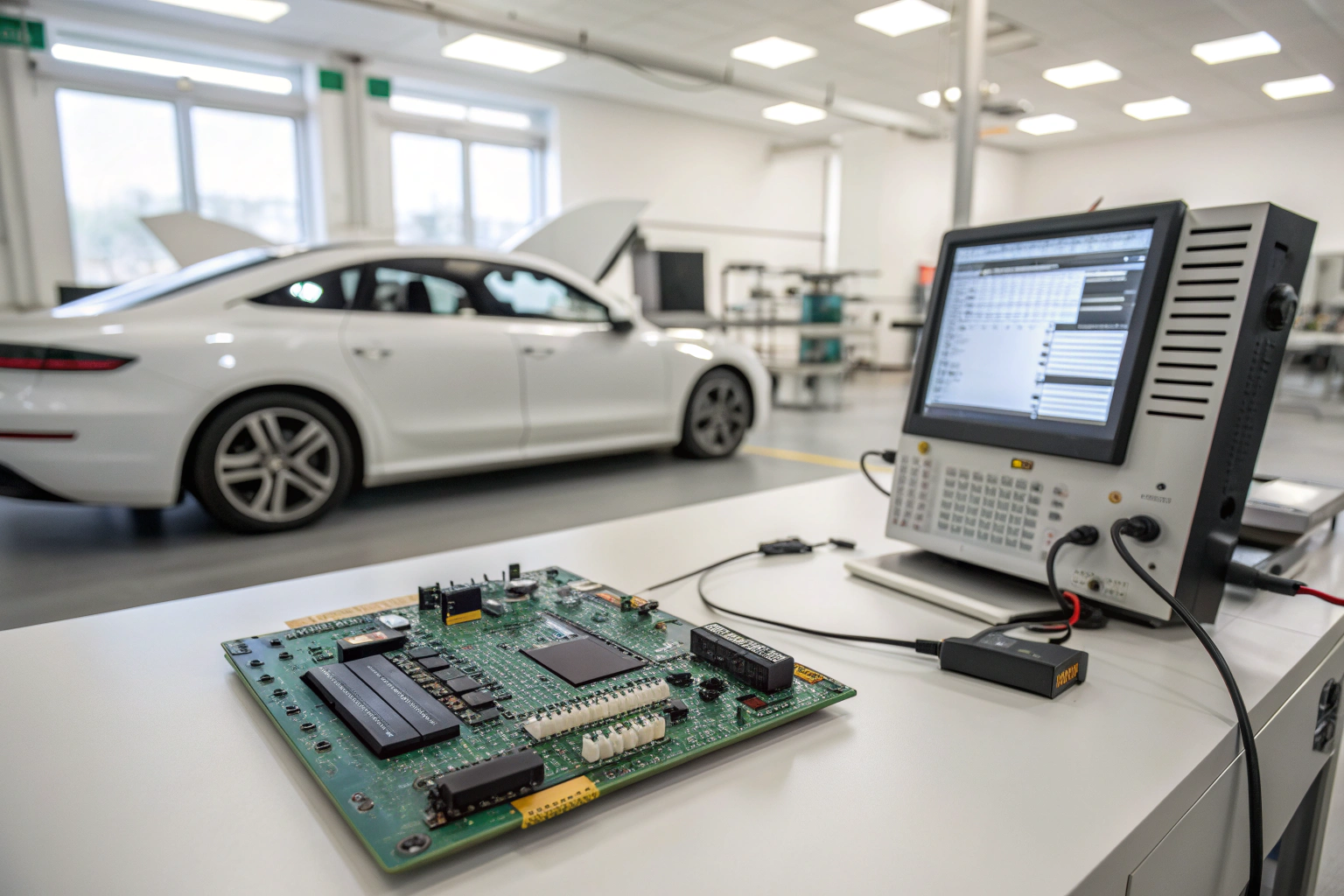
An soc automotive, or System on a Chip, is a single integrated circuit that centralizes a vehicle’s core electronic functions onto one microchip. This includes the processor (CPU), graphics (GPU), memory, and other essential modules needed to run everything from the infotainment system to advanced driver-assistance systems (ADAS). By combining these components, it streamlines vehicle design, enhances performance, and reduces complexity, enabling smarter and more connected cars.
Key Benefits at a Glance
- Increased Performance: Delivers the high-speed processing power needed for a smooth, responsive infotainment system and real-time ADAS calculations, directly improving driver safety and experience.
- Reduced Cost & Size: Consolidates multiple expensive components onto a single chip, significantly lowering manufacturing costs, saving valuable physical space, and reducing overall vehicle weight.
- Improved Energy Efficiency: Consumes far less power and generates less heat than using separate, distributed components, which is crucial for extending an electric vehicle’s battery range.
- Simplified Vehicle Architecture: Streamlines the complex electronic design, making it easier and faster for manufacturers to integrate, upgrade, and troubleshoot systems like cameras and sensors.
- Future-Proof Technology: Provides a single, powerful hub that enables seamless over-the-air (OTA) software updates, allowing manufacturers to add new features and improve performance over the vehicle’s lifetime.
Purpose of this guide
This guide is for automotive professionals, car buyers, and technology enthusiasts who want to understand the technology powering modern vehicles. It demystifies the role of automotive SoCs, explaining how they solve the challenge of managing increasingly complex electronic systems. You will learn how these chips enable critical safety features, advanced infotainment, and autonomous driving capabilities, helping you recognize their importance in a vehicle’s performance and long-term value.
System-on-Chip Technology: The Driving Force Behind My Work in Modern Automotive Innovation
After two decades working in automotive electronics, I've witnessed firsthand how System-on-Chip technology has fundamentally transformed the vehicles we drive today. What started as simple microcontrollers managing basic engine functions has evolved into sophisticated computing platforms that serve as the digital brain of modern vehicles. These integrated circuits now power everything from life-saving Advanced driver-assistance systems to immersive infotainment experiences, making vehicles safer, smarter, and more connected than ever before.
The automotive industry's adoption of System-on-Chip technology represents one of the most significant technological shifts I've experienced in my career. Where vehicles once relied on dozens of separate electronic control units, today's automotive SOCs integrate multiple computing functions onto a single chip, dramatically reducing complexity while enabling capabilities that seemed impossible just a few years ago. This integration has become essential as vehicles increasingly rely on real-time processing for safety-critical functions and seamless connectivity for the modern driving experience.
- SOCs integrate multiple computing functions onto a single chip, reducing size and power consumption
- Modern vehicles rely on SOCs for safety systems, connectivity, and infotainment features
- Automotive SOCs must meet stringent reliability and temperature requirements
- Integration of AI and machine learning capabilities is driving next-generation SOC development
- SOC technology enables real-time processing critical for autonomous driving features
My journey with automotive SOCs began when I recognized that traditional distributed computing architectures couldn't meet the demanding requirements of next-generation vehicles. The convergence of Automotive Cybersecurity threats and the need for Secure Connected Vehicles has made integrated SOC solutions not just preferable, but essential for maintaining both performance and security in modern automotive applications.
What Are Automotive SOCs and How I Work With Them
In my daily work, I define an automotive System-on-Chip as a complete computing system integrated onto a single semiconductor die, specifically designed to meet the unique challenges of vehicle environments. Unlike consumer electronics, automotive SOCs must operate reliably across extreme temperature ranges, withstand significant vibration and shock, and provide deterministic real-time performance for safety-critical applications.
The fundamental difference between automotive SOCs and traditional integrated circuits lies in their level of integration and specialization. While a conventional electronic system might require separate chips for processing, memory, communication, and power management, an automotive SOC consolidates these functions into a unified architecture. This integration reduces not only physical footprint and power consumption but also the complexity of inter-chip communication that can introduce latency and potential failure points.
Working with these embedded systems daily, I've come to appreciate how the central processing unit serves as the coordination hub, while specialized memory subsystems ensure rapid access to critical data. The communication interfaces enable seamless interaction with vehicle networks, sensors, and external connectivity modules. Each microchip component is carefully optimized for automotive requirements, creating a cohesive platform that can handle multiple concurrent tasks with the reliability and performance that vehicle safety demands.
Core Components I Work With in Automotive SOCs
Through my experience implementing automotive SOCs across various vehicle platforms, I've worked extensively with the core components that make these systems so powerful. The microprocessor serves as the computational heart, but modern automotive SOCs employ heterogeneous computing architectures that include specialized processing units optimized for specific tasks.
| Component Type | Primary Function | Automotive Benefits |
|---|---|---|
| CPU Cores | General processing and control | Real-time OS support, deterministic timing |
| GPU | Graphics and parallel processing | Advanced HMI, computer vision acceleration |
| DSP | Signal processing | Audio processing, sensor data filtering |
| NPU/AI Accelerator | Machine learning inference | Object detection, predictive analytics |
| Memory Controllers | Data storage and access | High-bandwidth sensor data handling |
| Communication Interfaces | External connectivity | CAN, Ethernet, wireless protocol support |
The memory architecture in automotive SOCs requires careful consideration of both performance and safety requirements. I've implemented systems with multiple memory tiers, from high-speed cache for critical real-time operations to larger system memory for application data and firmware storage. The communication subsystems must support diverse protocols simultaneously, from traditional CAN networks for vehicle control to high-speed Ethernet for advanced driver assistance features.
Power management becomes critically important in automotive applications, where energy efficiency directly impacts vehicle range and thermal management affects system reliability. The data processing capabilities must scale from simple sensor monitoring to complex control algorithms for autonomous driving features. Modern automotive SOCs excel at managing these diverse requirements through intelligent resource allocation and specialized communication protocols optimized for automotive networks.
My Experience: System-on-Module (SOM) vs. System-on-Chip (SOC)
Throughout my career, I've had to make critical decisions between implementing System-on-Chip solutions and system-on-module alternatives. This choice often determines project timelines, costs, and long-term maintainability. The decision typically comes down to integration requirements, development resources, and production volumes.
| Aspect | System-on-Chip (SOC) | System-on-Module (SOM) |
|---|---|---|
| Integration Level | Complete system on single die | SOC + supporting components on PCB |
| Size | Smallest footprint | Larger but still compact |
| Power Consumption | Optimized for efficiency | Slightly higher due to external components |
| Flexibility | Fixed configuration | Modular, swappable |
| Development Time | Longer initial design | Faster prototyping |
| Cost at Scale | Lower per unit | Higher due to additional components |
| Typical Use Cases | High-volume production | Rapid development, lower volumes |
I remember a particularly challenging project where we initially chose a SOM approach for rapid prototyping of an advanced driver assistance system. The printed circuit board flexibility allowed us to iterate quickly on the design, swapping different microprocessor modules as requirements evolved. However, when we moved to production volumes exceeding 100,000 units annually, the economics clearly favored a custom SOC solution that eliminated the intermediate PCB and reduced both cost and power consumption.
“Mainland China is the only major auto market aggressively pushing toward single-chip solutions.”
— S&P Global, August 2025
Source link
The choice between SOC and SOM often reflects broader industry trends and market pressures. In my experience, established automotive manufacturers tend to prefer SOMs for their flexibility during development phases, while newer electric vehicle manufacturers often opt for highly integrated SOC solutions to maximize efficiency and minimize component count from the start.
My Journey Through the Evolution of Automotive SOCs
Reflecting on my career trajectory, I've been privileged to witness and contribute to every major generation of automotive SOC development. The transformation has been remarkable, moving from simple 8-bit microcontrollers to today's sophisticated multi-core System-on-Chip platforms that rival desktop computers in capability while meeting the stringent requirements of the Automotive industry.
- First Generation (2000s): Basic microcontrollers for engine management and simple displays
- Second Generation (2010s): Multi-core processors enabling advanced infotainment and basic ADAS
- Third Generation (2015s): Heterogeneous computing with dedicated GPU and DSP for sensor fusion
- Fourth Generation (2020s): AI-enabled SOCs with neural processing units for autonomous features
- Fifth Generation (2025+): Quantum-enhanced processing and edge AI for fully autonomous vehicles
The early days of automotive electronics were dominated by simple, purpose-built controllers that managed specific vehicle functions in isolation. I remember working with 16-bit processors that seemed powerful at the time but could barely handle basic engine control algorithms. The leap to 32-bit ARM processors in the second generation opened up possibilities for more sophisticated human-machine interfaces and the first generation of driver assistance features.
The third generation marked a turning point in my career as heterogeneous computing became essential for managing the diverse computational requirements of modern vehicles. Dedicated graphics processors enabled high-resolution displays and real-time rendering, while digital signal processors handled the increasingly complex sensor data from cameras, radar, and lidar systems. This generation taught me the importance of balanced system architecture where different processing units work in harmony rather than competing for resources.
Today's fourth-generation SOCs represent the culmination of decades of automotive electronics evolution. The integration of neural processing units has enabled capabilities that seemed like science fiction just a few years ago. I've implemented systems that can identify pedestrians in complex urban environments, predict driver behavior, and make split-second decisions that can prevent accidents. The computational power available in a modern automotive SOC exceeds that of supercomputers from the early 2000s, yet these systems operate reliably in the harsh automotive environment.
How I've Seen SOCs Transform Vehicle Safety and ADAS
The most rewarding aspect of my work with automotive SOCs has been witnessing their transformative impact on vehicle safety. Advanced driver-assistance systems powered by modern System-on-Chip technology have fundamentally changed how vehicles perceive and respond to their environment. The integration of autonomous functionalities has progressed from simple cruise control to sophisticated systems that can prevent accidents before they occur.
- Adaptive Cruise Control: Maintains safe following distance using radar and camera fusion
- Lane Departure Warning: Computer vision algorithms detect lane markings in real-time
- Automatic Emergency Braking: Sub-100ms response time from obstacle detection to brake activation
- Blind Spot Monitoring: Continuous 360-degree environmental awareness using multiple sensors
- Traffic Sign Recognition: AI-powered image processing identifies and interprets road signs
- Pedestrian Detection: Machine learning models trained on diverse scenarios for accurate identification
The sensors in modern vehicles generate enormous amounts of data that require real-time processing with uncompromising accuracy and reliability. I've worked on systems where camera sensors alone produce over 1 gigabyte of data per second, requiring sophisticated System-on-Chip architectures that can process this information with the speed necessary for collision avoidance decisions. The challenge isn't just computational power but ensuring deterministic performance under all conditions.
One of my most memorable projects involved developing an adaptive cruise control system that could operate safely in stop-and-go traffic. The SOC had to simultaneously process radar returns, camera images, and vehicle dynamics data while maintaining precise speed control and safe following distances. The lane departure warning functionality added another layer of complexity, requiring real-time analysis of road markings and vehicle position with millimeter precision.
My Approach to Real-time Processing for Critical Safety Systems
Working with real-time processing for safety-critical automotive applications has taught me that computational power alone isn't sufficient. The System-on-Chip must provide predictable, deterministic performance where timing is as important as accuracy. Sensors generate continuous data streams that must be processed within strict deadlines to ensure safety systems respond appropriately to rapidly changing conditions.
My approach to implementing real-time processing begins with understanding the timing requirements of each safety function. Emergency braking systems require response times under 100 milliseconds from obstacle detection to brake activation. This constraint drives every aspect of the system design, from sensor selection to memory architecture to software optimization. I've learned that buffering strategies and interrupt handling become critical design elements that can make the difference between a system that works in laboratory conditions and one that saves lives on public roads.
The integration of multiple sensor types creates unique challenges for real-time processing. Camera data provides rich visual information but requires significant computational resources for object recognition. Radar sensors offer reliable distance measurements but generate data in a completely different format. Lidar systems provide precise 3D mapping but produce massive point clouds that stress memory bandwidth. The SOC architecture must handle these diverse data streams simultaneously while maintaining the timing requirements for safety-critical decisions.
I've implemented sensor fusion algorithms that combine information from multiple sources to create a more accurate and reliable perception of the vehicle's environment. The System-on-Chip serves as the central coordination point where disparate sensor data converges into actionable intelligence. Machine learning models running on dedicated neural processing units can identify patterns and predict potential hazards faster than traditional algorithmic approaches, but they require careful validation to ensure consistent performance across diverse operating conditions.
“The Lynk & Co 900, a plug-in hybrid electric vehicle, features two Snapdragon 8295 chips, offering a combined 60 tera operations per second (TOPS) of AI performance.”
— S&P Global, August 2025
Source link
Connectivity and Infotainment: How I Use SOCs as the Brain of Modern Vehicles
The evolution from basic car radios to today's sophisticated digital cockpits represents one of the most visible transformations enabled by System-on-Chip technology. Modern Connectivity and Infotainment systems demand computational capabilities that rival smartphones and tablets, yet they must operate reliably in the challenging automotive environment while integrating seamlessly with vehicle systems.
My experience with automotive infotainment began when displays were simple monochrome text screens showing basic radio information. Today's systems feature multiple high-resolution displays, voice recognition, gesture control, and augmented reality navigation. The System-on-Chip serves as the central hub that coordinates these diverse interfaces while maintaining connections to cloud services, smartphones, and vehicle networks simultaneously.
The challenge of implementing modern connectivity solutions lies in balancing user expectations with automotive requirements. Consumers expect their vehicles to provide the same responsive, feature-rich experience they enjoy with mobile devices. However, automotive systems must maintain this performance across temperature extremes, electrical noise, and mechanical vibration that would disable consumer electronics. The SOC architecture must provide sufficient computational headroom to handle peak loads while maintaining efficient power consumption during normal operation.
How I Enable Seamless Vehicle Connectivity
Implementing comprehensive Connectivity solutions through System-on-Chip platforms requires supporting multiple wireless standards simultaneously while maintaining isolation between different communication channels. Modern vehicles must connect to cellular networks for cloud services, Wi-Fi networks for high-bandwidth data transfer, Bluetooth devices for personal connectivity, and emerging V2X protocols for vehicle-to-vehicle communication.
- 5G/LTE: High-speed cellular connectivity for cloud services and OTA updates
- Wi-Fi 6: Local hotspot capability and high-bandwidth data transfer
- Bluetooth 5.0+: Low-energy device pairing and audio streaming
- V2X (Vehicle-to-Everything): Communication with infrastructure and other vehicles
- Ethernet: High-speed in-vehicle networking backbone
- CAN/CAN-FD: Traditional automotive bus protocols for legacy compatibility
The complexity of managing multiple connectivity standards on a single SOC requires careful resource allocation and interference management. I've worked on systems where cellular, Wi-Fi, and Bluetooth radios share antenna systems and must coordinate their transmission schedules to avoid interference. The System-on-Chip serves as the intelligent coordinator that manages these interactions while maintaining optimal performance for each protocol.
Security considerations become paramount when implementing vehicle connectivity. Each communication channel represents a potential attack vector that could compromise vehicle safety or user privacy. I've implemented multi-layered security architectures where the SOC provides hardware-based encryption and secure boot capabilities while maintaining separation between safety-critical vehicle networks and external connectivity interfaces.
My Work Revolutionizing In-Vehicle Entertainment
The transformation of Infotainment systems from simple audio players to comprehensive multimedia platforms has been driven largely by advances in System-on-Chip technology. Modern vehicles offer experiences that rival home theater systems, with multiple display zones, immersive audio processing, and personalized content delivery tailored to individual passengers.
| SOC Tier | Processing Power | Infotainment Capabilities | Typical Applications |
|---|---|---|---|
| Entry-Level | Dual-core ARM | Basic audio, simple displays | Economy vehicles, basic systems |
| Mid-Range | Quad-core + GPU | HD video, voice control, smartphone integration | Mainstream vehicles, standard infotainment |
| High-End | Octa-core + dedicated AI | 4K displays, AR navigation, multi-zone entertainment | Luxury vehicles, premium systems |
| Ultra-Premium | Custom silicon + NPU | Real-time rendering, personalized AI, immersive experiences | Electric vehicles, autonomous platforms |
I've implemented infotainment systems that support simultaneous 4K video playback across multiple displays while maintaining responsive touch interfaces and processing voice commands in real-time. The computational requirements for these features would have been impossible with earlier generation SOCs, but modern heterogeneous architectures excel at parallel processing tasks that characterize multimedia applications.
The integration of artificial intelligence into infotainment systems has opened new possibilities for personalized experiences. Machine learning algorithms running on neural processing units can learn individual preferences for music, navigation routes, climate control, and seat adjustments. The System-on-Chip becomes a learning platform that adapts to user behavior over time while protecting personal data through on-device processing rather than cloud-based analytics.
Voice recognition and natural language processing represent particular challenges for automotive infotainment systems. The acoustic environment inside a vehicle includes road noise, engine sounds, and multiple simultaneous conversations. I've implemented noise cancellation algorithms and beamforming techniques that leverage the SOC's digital signal processing capabilities to isolate voice commands from background noise while maintaining privacy through local speech processing.
Challenges I've Faced in Automotive SOC Design and Implementation
My journey implementing automotive SOCs has taught me that the Automotive industry presents unique challenges that distinguish it from consumer electronics or industrial applications. The combination of harsh operating environments, stringent safety requirements, and long product lifecycles creates a complex set of constraints that must be addressed from the earliest stages of System-on-Chip design.
- Thermal Management: Automotive SOCs must operate reliably from -40°C to +125°C
- Power Efficiency: Battery-powered vehicles demand ultra-low power consumption
- EMI/EMC Compliance: Electromagnetic interference can disrupt critical safety systems
- Supply Chain Security: Ensuring authentic components throughout manufacturing
- Long-term Support: Automotive lifecycles require 15+ years of component availability
- Integration Complexity: Managing interactions between multiple subsystems and protocols
Thermal management has consistently been one of the most challenging aspects of automotive SOC implementation. Unlike consumer electronics that operate in controlled environments, automotive systems must function reliably whether parked in Death Valley summer heat or during an Arctic winter. I've learned that thermal design cannot be an afterthought but must be integrated into every level of system architecture, from silicon design to packaging to system-level heat dissipation.
Power efficiency becomes critically important in electric and hybrid vehicles where every watt of consumption directly impacts driving range. I've implemented sophisticated power management strategies that dynamically adjust SOC performance based on vehicle operating mode and available energy. During highway cruising, the system can operate at full performance for advanced driver assistance features. When parked, the SOC must maintain minimal functionality for security and connectivity while consuming virtually no power.
Electromagnetic interference and compatibility represent ongoing challenges as vehicles become more electronic and wireless connectivity becomes ubiquitous. I've encountered situations where cellular radio transmission interfered with GPS reception, or where LED headlight switching created noise that affected radio reception. The SOC design must include comprehensive filtering and shielding strategies while maintaining signal integrity for high-speed digital interfaces.
How I Meet Stringent Automotive Standards
Navigating the complex landscape of automotive standards has been essential to my success in SOC implementation. ISO 26262 serves as the foundation for Functional safety in automotive systems, but it represents just one element of a comprehensive regulatory framework that governs System-on-Chip design and deployment in the Automotive industry.
Compliance with ASIL-D demands rigorous verification and documentation—a process I align with standards like ISO 26262 software compliance, ensuring every module in the SoC meets its allocated safety goal.
| Standard | Focus Area | SOC Requirements | Compliance Impact |
|---|---|---|---|
| ISO 26262 | Functional Safety | ASIL-rated components, fault detection | Safety-critical system validation |
| AEC-Q100 | Component Qualification | Stress testing, reliability validation | Automotive-grade component certification |
| AUTOSAR | Software Architecture | Standardized interfaces, modularity | Software portability and integration |
| ISO 21434 | Cybersecurity | Secure boot, encryption, intrusion detection | Protection against cyber threats |
| ASPICE | Process Quality | Development process compliance | Systematic quality assurance |
My approach to standards compliance begins during the earliest phases of SOC architecture design. ISO 26262 requirements influence fundamental decisions about processor redundancy, memory protection, and fault detection mechanisms. I've learned that retrofitting safety features into an existing design is far more expensive and complex than incorporating them from the beginning. The standard's emphasis on systematic development processes has actually improved my overall design methodology, even for non-safety-critical applications.
AEC-Q100 qualification represents a significant milestone for any automotive SOC, requiring extensive stress testing across temperature, humidity, vibration, and electrical parameters. I've participated in qualification programs that span multiple years and involve thousands of test samples. The investment in qualification is substantial, but it provides confidence that the SOC will perform reliably throughout the vehicle's operational lifetime.
Cybersecurity standards like ISO 21434 have become increasingly important as vehicles become more connected and autonomous. The standard requires a systematic approach to identifying and mitigating cybersecurity risks throughout the product lifecycle. I've implemented hardware security modules, secure boot sequences, and over-the-air update mechanisms that maintain security while enabling necessary functionality updates.
My Functional Safety Aware Design Process
Implementing Functional safety in System-on-Chip design requires a systematic approach that addresses potential failures at every level of the system hierarchy. My methodology follows ISO 26262 requirements while incorporating practical lessons learned from years of automotive electronics development.
To meet ISO 26262 requirements, I integrate hardware-enforced isolation and fault containment units, often leveraging a silicon root of trust to anchor secure boot and runtime integrity checks—ensuring the SoC remains uncompromised even under attack.
- Hazard Analysis: Identify potential failure modes and their safety impact
- Safety Requirements: Define ASIL levels and safety goals for each function
- Architecture Design: Implement redundancy and fault detection mechanisms
- Safety Validation: Verify safety measures through testing and analysis
- Documentation: Maintain comprehensive safety case throughout development
- Continuous Monitoring: Implement runtime safety monitoring and diagnostics
The hazard analysis phase forms the foundation of all subsequent safety work. I begin by systematically examining how each SOC function could fail and what impact those failures might have on vehicle safety. A processor lockup during emergency braking represents a different risk level than a failure in the entertainment system. This analysis drives the assignment of Automotive Safety Integrity Levels (ASIL) that determine the rigor required for each system component.
Safety requirements definition translates abstract safety goals into concrete technical specifications. For example, a safety goal of "prevent unintended acceleration" becomes specific requirements for sensor redundancy, input validation, and fault response timing. I've learned that clear, measurable safety requirements are essential for successful verification and validation activities later in the development process.
Architecture design for functional safety often requires redundancy and diversity that increase SOC complexity and cost. I've implemented dual-core lockstep processors for critical control functions, where two identical cores execute the same software simultaneously and compare results to detect hardware failures. Memory protection units prevent software faults in one application from affecting safety-critical functions. Watchdog timers monitor system health and initiate safe shutdown sequences when faults are detected.
How I Navigate Manufacturing and Production of Automotive SOCs
The transition from prototype System-on-Chip designs to high-volume automotive production presents unique challenges that distinguish automotive manufacturing from other semiconductor markets. The Automotive industry demands quality levels and traceability requirements that exceed those of consumer electronics while maintaining cost targets compatible with vehicle economics.
My experience with automotive SOC manufacturing has taught me that quality cannot be inspected into the product but must be built into every stage of the process. Automotive-grade semiconductor fabrication requires specialized process controls, enhanced testing procedures, and comprehensive documentation that enables full traceability from raw materials to finished vehicles. The investment in manufacturing quality pays dividends through reduced field failures and warranty costs.
Working with semiconductor foundries to establish automotive-grade production lines requires close collaboration and shared commitment to quality objectives. I've participated in foundry qualification programs that evaluate everything from clean room procedures to statistical process control systems. The goal is ensuring that manufacturing variability remains within tight bounds that guarantee consistent SOC performance across all production units.
The testing and validation requirements for automotive SOCs far exceed those of consumer electronics. I've implemented comprehensive test programs that evaluate electrical parameters, thermal performance, and functional behavior across the full range of operating conditions. Automotive test programs typically require 100% functional testing of every device, along with statistical sampling for extended stress tests and reliability validation.
My Optimization Cycle and Continuous Improvement Approach
Continuous improvement in System-on-Chip development requires systematic feedback collection and iterative refinement of both design processes and product performance. My approach emphasizes data-driven optimization based on measurable metrics from development, production, and field operation.
- Performance Profiling: Regular benchmarking against real-world automotive workloads
- Power Analysis: Continuous monitoring of power consumption across all operating modes
- Thermal Optimization: Iterative heat dissipation improvements through design refinement
- Software-Hardware Co-design: Balanced optimization of firmware and silicon architecture
- Field Feedback Integration: Incorporating real-world performance data into next iterations
- Predictive Maintenance: Using AI to anticipate and prevent potential system failures
Performance profiling has become essential as automotive workloads become increasingly complex and diverse. I regularly benchmark SOC performance against representative automotive applications, including sensor fusion algorithms, machine learning inference, and real-time control loops. This profiling identifies bottlenecks and optimization opportunities that might not be apparent from synthetic benchmarks.
Power analysis extends beyond simple average consumption measurements to examine dynamic power behavior across all operating modes. Automotive systems experience dramatic load variations, from idle states during parking to peak performance during emergency maneuvers. I've implemented sophisticated power monitoring that tracks consumption at microsecond resolution to identify optimization opportunities and validate power management algorithms.
Thermal optimization requires iterative refinement based on both simulation and empirical measurements. I've learned that thermal hotspots can create reliability issues even when average junction temperatures remain within specifications. Advanced thermal modeling combined with infrared imaging of operating systems helps identify and eliminate thermal problems before they affect field reliability.
The continuous optimization cycle creates a feedback loop where each generation of SOC design incorporates lessons learned from previous implementations. Field data from deployed vehicles provides invaluable insights into real-world performance that cannot be replicated in laboratory testing. I've used this data to refine algorithms, adjust thermal management strategies, and improve fault detection mechanisms in subsequent product generations.
Future Trends in Automotive SOC Technology I'm Watching
Based on my experience and ongoing research in automotive electronics, I see several transformative trends that will reshape System-on-Chip technology over the next decade. The convergence of AI capabilities with Autonomous driving requirements is driving fundamental changes in SOC architecture and capabilities that will enable new vehicle functions previously thought impossible.
- Edge AI Integration: Dedicated neural processing units for real-time machine learning inference
- Quantum-Enhanced Security: Quantum-resistant encryption and secure communication protocols
- Heterogeneous Computing: Specialized accelerators for specific automotive workloads
- Software-Defined Vehicles: Reconfigurable hardware supporting over-the-air functionality updates
- Autonomous Driving Platforms: Ultra-low latency processing for Level 4/5 autonomous systems
Edge AI integration represents the most significant near-term trend I'm tracking. The computational requirements for real-time machine learning inference in automotive applications are driving the development of specialized neural processing units that can execute complex models with minimal latency and power consumption. I'm currently working with SOCs that include dedicated AI accelerators capable of processing multiple camera feeds simultaneously while identifying objects, predicting behavior, and making driving decisions in real-time.
Quantum-enhanced security technologies are emerging as essential capabilities for future connected vehicles. As quantum computing advances threaten traditional encryption methods, automotive SOCs must incorporate quantum-resistant cryptographic algorithms and potentially quantum key distribution systems. I'm participating in early research programs that explore how quantum technologies can enhance both security and computational capabilities in automotive applications.
Heterogeneous computing architectures are evolving beyond simple CPU-GPU combinations to include specialized accelerators for specific automotive workloads. I'm seeing the emergence of dedicated units for sensor fusion, path planning, and real-time control that can execute these functions more efficiently than general-purpose processors. This specialization enables higher performance while reducing power consumption and improving deterministic timing behavior.
Software-defined vehicles represent a paradigm shift where SOC capabilities can be reconfigured and enhanced through over-the-air updates. I'm working on architectures that support dynamic reconfiguration of hardware resources based on current vehicle needs and emerging requirements. This flexibility enables new business models where vehicle capabilities can be upgraded throughout the ownership lifecycle.
My Key Considerations When Selecting SOCs for Automotive Applications
After years of evaluating and implementing System-on-Chip solutions across diverse Automotive industry applications, I've developed a systematic approach to SOC selection that balances technical requirements with practical constraints. The decision process must consider not only current needs but also future requirements and long-term support availability.
Beyond raw performance, I evaluate how well a SoC supports platform-wide strategies—something I learned from my experience as a platform architect, where cross-domain interoperability and lifecycle cost often outweigh peak specs.
- DO: Evaluate long-term roadmap and supplier commitment to automotive market
- DO: Verify compliance with relevant automotive standards and certifications
- DO: Consider total system cost including development tools and support
- DO: Assess thermal performance under worst-case automotive conditions
- DON’T: Choose based solely on peak performance specifications
- DON’T: Overlook power consumption in all operating modes
- DON’T: Underestimate integration complexity and development timeline
- DON’T: Ignore cybersecurity features and update mechanisms
My evaluation process begins with understanding the complete system requirements rather than focusing solely on processor performance metrics. Automotive applications often require balanced capabilities across processing, memory bandwidth, I/O flexibility, and real-time performance. I've learned that peak benchmark scores rarely correlate with real-world automotive performance, where deterministic timing and worst-case behavior often matter more than average throughput.
Supplier evaluation has become increasingly important as automotive SOC complexity increases and development timelines extend. I evaluate not only the technical capabilities of the SOC but also the supplier's commitment to automotive markets, long-term roadmap alignment, and support infrastructure. Automotive projects often span 5-7 years from initial design to production, requiring sustained supplier engagement throughout the development lifecycle.
Total cost of ownership extends far beyond the SOC unit price to include development tools, software licensing, engineering support, and long-term availability. I've encountered situations where an initially lower-cost SOC became expensive due to limited development tool availability or inadequate technical support. Comprehensive cost analysis must include all elements required for successful product development and sustained production.
My Work with Industrial Applications Beyond Passenger Vehicles
The principles and technologies I've developed for passenger vehicle System-on-Chip applications have found valuable applications in commercial vehicles, industrial equipment, and specialized transportation systems. The Automotive industry encompasses far more than passenger cars, and SOC technology is transforming these diverse applications as well.
My experience with commercial vehicle applications has highlighted unique requirements that distinguish them from passenger vehicles. Long-haul trucks operate under different duty cycles and environmental conditions than passenger cars. Construction equipment faces extreme vibration and contamination that challenges standard automotive SOCs. Marine and aerospace applications require enhanced reliability and fault tolerance beyond typical automotive standards.
Industrial automation and off-highway equipment represent growing markets for automotive-grade SOC technology. I've adapted passenger vehicle SOC architectures for agricultural equipment that operates autonomously in fields, mining equipment that functions in harsh underground environments, and material handling systems that require precise coordination and safety monitoring. These applications often require enhanced I/O capabilities and specialized communication protocols while maintaining the reliability and environmental tolerance of automotive systems.
The adaptability of modern SOC architectures enables customization for diverse industrial applications while leveraging the development investment and production volumes of the automotive market. I've implemented systems where the same core SOC supports passenger vehicle infotainment, commercial vehicle fleet management, and industrial equipment monitoring through different software configurations and peripheral interfaces. This commonality reduces development costs and improves long-term support availability across diverse application domains.
Frequently Asked Questions
An automotive SoC, or System on Chip, is an integrated circuit that combines multiple computing components like processors, memory, and peripherals into a single chip designed for vehicle applications. These SoCs power essential functions in modern cars, including engine management, infotainment, and safety systems, offering compact and efficient solutions. Understanding automotive SoC technology is key to appreciating advancements in vehicle electronics.
Automotive SoCs provide significant benefits such as reduced size and weight by integrating multiple functions into one chip, which lowers manufacturing costs and improves fuel efficiency. They also offer enhanced performance with faster processing and lower power consumption, crucial for battery-powered electric vehicles. Overall, automotive SoCs enable more reliable and scalable systems in modern automobiles.
In ADAS, automotive SoCs process real-time data from sensors like cameras, lidar, and radar to enable features such as adaptive cruise control, lane-keeping assistance, and automatic emergency braking. These chips integrate AI algorithms for quick decision-making, enhancing vehicle safety and driver convenience. The evolution of automotive SoC technology continues to drive innovations in ADAS capabilities.
Leading automotive SoC suppliers include NVIDIA, Qualcomm, Intel (through Mobileye), Renesas Electronics, and NXP Semiconductors, which specialize in chips for vehicle computing needs. These companies provide robust solutions tailored for automotive standards, focusing on reliability and performance. Partnering with top automotive SoC suppliers ensures access to cutting-edge technology for car manufacturers.
Automotive SoCs are evolving with increased computational power, AI integration, and support for high-bandwidth connectivity like 5G to handle the demands of autonomous driving, such as processing vast sensor data in real time. They incorporate advanced security features to protect against cyber threats and ensure functional safety. This progression in automotive SoC design is pivotal for achieving higher levels of vehicle autonomy.

Hi, I’m Liam Hamilton — a tech enthusiast and developer with years of hands-on programming experience. This blog is my space to share practical advice, explore the latest trends in the IT world, and break down complex tech concepts into simple, understandable insights. I believe technology should be accessible to everyone who wants to stay ahead in the digital era.
[…] insight into how these memory types function within complete silicon designs, see our breakdown of SoC automotive integration patterns and the role of memory subsystems in modern chip […]
[…] Automotive networks increasingly adopt Ethernet PHY for high-bandwidth in-vehicle communication. Integrating these PHYs requires SoC designs optimized for automotive safety and EMI resilience. Explore domain-specific requirements in automotive SoC. […]
[…] computational backbone of modern autonomous systems is increasingly based on specialized automotive SoCs that integrate CPU clusters, AI accelerators, and safety islands into a single silicon […]
Way cool! Soome extremsly valid points! I appreciate you writing thiis article and thee
resat oof the website iss realy good.
my homepage :: xnxx18.pro