
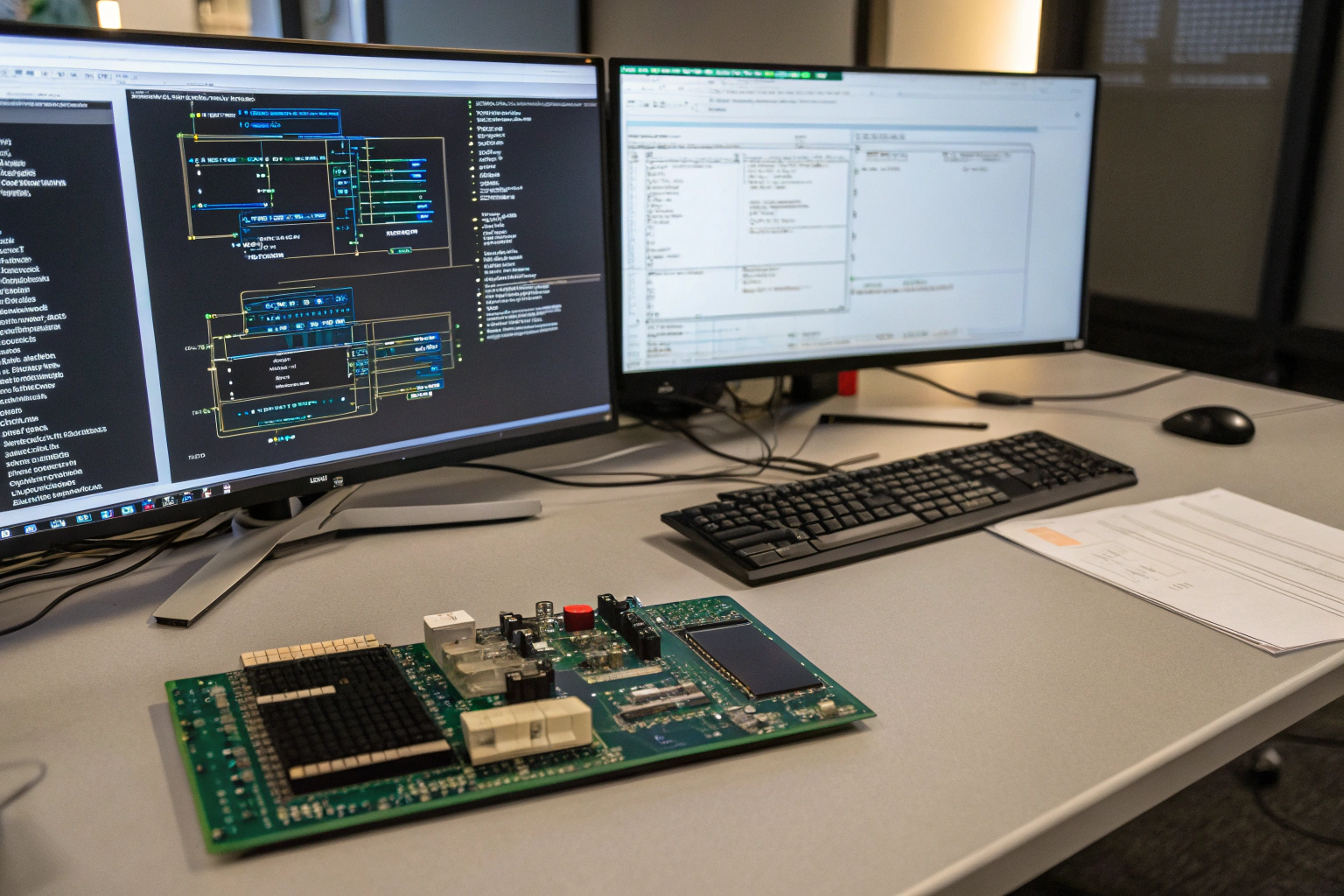
A design verification engineer embedded is a specialized engineer responsible for ensuring that the electronic hardware and firmware of an embedded system function correctly before production. They create sophisticated testing environments using languages like SystemVerilog to simulate real-world conditions, identify design flaws, and validate that the product meets all specifications. This critical role prevents costly bugs and ensures the safety and reliability of devices like smartphones, automotive controls, and medical equipment.
Key Benefits at a Glance
- Critical Impact: Directly contribute to the safety and reliability of everyday products, from cars to medical implants.
- Cost Savings: Prevent millions in losses by identifying and fixing hardware design flaws before expensive manufacturing starts.
- High-Value Skills: Master in-demand programming and verification languages like SystemVerilog and UVM, ensuring strong job security.
- Complex Problem-Solving: Engage your analytical skills daily by hunting for subtle bugs in complex, cutting-edge electronic systems.
- Diverse Industry Access: Build a versatile career with opportunities in leading sectors, including consumer electronics, aerospace, and IoT.
Purpose of this guide
This guide is for students, aspiring engineers, and tech professionals curious about what a career in embedded design verification entails. It breaks down the core responsibilities of the role, clarifies its critical importance in preventing costly product failures, and outlines the essential technical and analytical skills needed to succeed. You will learn how these engineers act as the first line of defense against hardware bugs, ensuring the reliability of the technology we use every day and understanding common mistakes to avoid during the verification process.
Introduction: my journey into verification engineering
When I first stumbled into the world of design verification engineering fifteen years ago, I had no idea I was entering one of the most critical yet underappreciated fields in embedded systems development. What started as a temporary assignment debugging simulation failures quickly became my passion and expertise. Today, as a seasoned design verification engineer specializing in embedded systems, I've witnessed firsthand how thorough pre-silicon verification can make the difference between a successful product launch and a catastrophic recall.
I'll never forget the project that truly opened my eyes to the importance of our work. While verifying a complex automotive SoC destined for advanced driver assistance systems, my team discovered a subtle timing violation that occurred only under specific temperature and voltage conditions. The design team initially dismissed it as a simulation artifact, but I persisted with additional corner-case testing. That persistence paid off when we reproduced the failure in silicon, potentially preventing thousands of vehicles from experiencing critical safety system failures. The estimated cost savings from catching this bug pre-production exceeded $50 million, not to mention the invaluable protection of human lives.
This experience crystallized my understanding of what makes design verification engineers indispensable in the embedded systems landscape. We serve as the guardians of quality, the detectives who hunt down elusive bugs, and the final checkpoint before designs move into expensive fabrication processes. The verification process we execute isn't just about finding problems – it's about ensuring that the complex embedded systems powering everything from smartphones to spacecraft perform reliably under all conceivable conditions.
- Design verification prevents costly production errors that can cost millions in recalls
- Embedded systems verification requires specialized expertise in hardware-software interaction
- Pre-silicon verification catches 80% of design flaws before expensive fabrication
- Verification engineers serve as the final quality gate before production
What I do as a design verification engineer
As a design verification engineer working in the embedded systems domain, my role centers on ensuring that complex hardware designs function correctly before they're committed to silicon. I spend my days creating comprehensive test environments, developing sophisticated testbenches, and executing thousands of simulation scenarios to uncover potential design flaws that could prove catastrophic in production.
The heart of my work involves what I call "constructive paranoia" – systematically questioning every aspect of a design and creating scenarios that stress-test the hardware beyond its intended operating conditions. When working on an FPGA-based industrial controller last year, I discovered a critical race condition that occurred only when multiple high-priority interrupts arrived within a specific timing window. The original design specification hadn't considered this scenario, but real-world industrial environments are notoriously unpredictable. My verification process caught this issue during simulation, preventing potential equipment damage and production line shutdowns.
My responsibilities span the entire development lifecycle, from initial specification review through final sign-off. I collaborate closely with design engineers to understand architectural decisions, work with system architects to ensure compliance with requirements, and coordinate with software teams to verify hardware-software interfaces. This interdisciplinary approach is essential because modern embedded systems are incredibly complex, integrating multiple subsystems that must work seamlessly together.
| Hardware Target | Verification Focus | Key Challenges |
|---|---|---|
| FPGA | Logic functionality and timing | Resource constraints and clock domain crossing |
| ASIC | Manufacturing readiness and power | One-time fabrication cost and yield optimization |
| SoC | System integration and interfaces | Complex subsystem interactions and software compatibility |
The financial stakes in my work cannot be overstated. A single missed bug in an ASIC can result in a complete re-spin, costing hundreds of thousands of dollars in mask costs alone, not to mention months of schedule delays. For SoC designs, the complexity multiplies exponentially as we must verify not just individual components but their intricate interactions. FPGA projects offer more flexibility for post-deployment fixes, but thorough verification remains crucial for customer confidence and market success.
- Analyze design specifications and requirements
- Develop comprehensive verification plans
- Create testbenches and simulation environments
- Execute test cases and analyze results
- Collaborate with design teams on bug fixes
- Document verification coverage and sign-off
My work spans multiple domains, from ASIC verification with formal methods and constrained-random testing to mixed-signal and SoC-level verification challenges.
How verification has evolved during my career
The transformation I've witnessed in verification practices over the past fifteen years has been remarkable. When I started, verification was often an afterthought, squeezed into tight project schedules with limited resources. Today, it's recognized as a critical discipline that can make or break product success, especially as embedded systems have proliferated into safety-critical applications.
The rise of IoT devices, automotive electronics, and medical embedded systems has fundamentally changed how we approach verification. Where we once focused primarily on functional correctness, we now must consider security vulnerabilities, power consumption, thermal management, and compliance with stringent safety standards like ISO 26262 for automotive applications. This evolution has driven the development of sophisticated verification methodologies that can handle the increased complexity and criticality of modern designs.
I've seen the industry embrace formal verification methods, constrained random testing, and coverage-driven verification as standard practices rather than experimental techniques. The introduction of Universal Verification Methodology (UVM) revolutionized how we structure testbenches, making them more reusable and maintainable across projects. Machine learning and AI are now beginning to influence verification, helping us identify patterns in bug discovery and optimize test generation.
Over the years, I’ve seen verification methodologies shift from ad-hoc testing to structured, coverage-driven flows—especially critical in complex SoC environments where systematic IC test methodology for SoCs ensures robustness before tape-out.
How I distinguish between verification and validation
One of the most common misconceptions I encounter is the conflation of verification and validation. While both are essential quality assurance activities, they serve distinctly different purposes in the embedded system development process. Verification asks "are we building the product right?" while validation asks "are we building the right product?"
In my daily work as a design verification engineer, I focus primarily on the verification side – ensuring that our hardware implementation correctly realizes the specified design. This involves extensive simulation, formal analysis, and emulation to prove that the design behaves according to its specifications under all possible operating conditions. Validation, on the other hand, occurs later in the development cycle and focuses on whether the complete system meets user needs and market requirements.
| Verification | Validation |
|---|---|
| Building the product right | Building the right product |
| Pre-production testing | Post-production testing |
| Design meets specifications | Product meets user needs |
| Simulation and formal methods | Real-world testing scenarios |
| Internal quality focus | Customer satisfaction focus |
I learned this distinction the hard way during a project where our verification team successfully proved that a wireless communication controller met all specified requirements. However, validation testing revealed that the power consumption specifications, while technically correct, made the device unsuitable for battery-powered applications – the primary target market. This experience taught me the importance of understanding both verification and validation perspectives, even though my primary responsibility remains in the verification domain.
While verification asks “Did we build the thing right?”, validation confirms “Did we build the right thing?”—a distinction vividly illustrated in contexts like SoC validation, where real-world use cases validate architectural intent.
Attributes that have made me successful in verification
Reflecting on my career progression and observing successful colleagues, I've identified several key attributes that distinguish exceptional verification engineers from merely competent ones. The most critical trait is what I call "constructive skepticism" – the ability to question assumptions and imagine failure scenarios that others might overlook.
Attention to detail is obviously crucial, but it goes beyond just catching typos in code. Successful verification engineers develop an intuition for where bugs like to hide. They understand that the most dangerous bugs often lurk at interfaces between subsystems, in rarely exercised code paths, and in corner cases that seem too unlikely to matter. I've found some of my most significant bugs by asking "what if" questions that initially seemed ridiculous.
The ability to think systematically while maintaining creativity has served me well throughout my career. Verification requires methodical planning and execution, but it also demands creative thinking to devise test scenarios that expose design weaknesses. Some of my most effective test cases have come from combining systematic coverage analysis with imaginative "what could go wrong" brainstorming sessions.
- Develop obsessive attention to detail – bugs hide in the smallest oversights
- Cultivate systematic thinking to break complex problems into manageable pieces
- Build strong debugging intuition through hands-on experience with failures
- Maintain curiosity about edge cases that others might overlook
- Practice clear communication to explain technical issues to diverse stakeholders
Communication skills have become increasingly important as verification has evolved from a solitary debugging activity to a collaborative discipline. I regularly present findings to design teams, explain coverage gaps to project managers, and translate technical issues into business impact for executive stakeholders. The ability to tell a compelling story about why a particular bug matters can mean the difference between getting the resources needed for thorough verification and being pressured to skip critical test scenarios.
My daily responsibilities as a verification engineer
My typical day begins with reviewing overnight simulation results, a ritual that sets the tone for everything that follows. Modern verification processes involve running thousands of test cases continuously, and each morning brings a new batch of results to analyze. Some days I'm greeted with clean regression results that validate recent design changes, while other days reveal new failures that require immediate investigation.
Beyond functional verification, I collaborate with DFT teams on design for test strategies and ATPG methodologies to ensure manufacturability and testability of silicon.
The bulk of my time is spent in what I consider the core activities of verification: developing testbenches, writing test cases, and analyzing results. Working primarily in SystemVerilog with UVM frameworks, I create sophisticated test environments that can generate millions of different stimulus patterns and automatically check for correct responses. Debugging failures often feels like detective work, requiring me to trace through waveforms, correlate multiple signal interactions, and sometimes dive deep into design implementation details to understand root causes.
| Activity | Tools Used | Time Investment | Impact |
|---|---|---|---|
| Verification Planning | Requirements docs, spreadsheets | 15% | Defines project scope and success criteria |
| Testbench Development | SystemVerilog, UVM | 40% | Creates infrastructure for comprehensive testing |
| Test Execution | Simulators, debug tools | 25% | Validates design functionality and performance |
| Bug Analysis | Waveform viewers, debuggers | 15% | Identifies root causes and provides fix guidance |
| Documentation | Reports, coverage tools | 5% | Ensures traceability and knowledge transfer |
Collaboration consumes a significant portion of my day, though it's often the most rewarding aspect of the job. I work closely with design engineers to understand architectural decisions and discuss potential verification approaches. These conversations are crucial because they help me develop test strategies that align with design intent while still challenging assumptions. Regular meetings with project stakeholders keep everyone informed about verification progress and help prioritize efforts when schedules become tight.
The administrative aspects of my role – documentation, coverage analysis, and status reporting – might seem mundane, but they're essential for maintaining verification quality and project visibility. I've learned that thorough documentation not only helps with knowledge transfer but also serves as a valuable resource when similar issues arise in future projects.
- Review overnight simulation results and identify any new failures
- Prioritize bug investigation based on severity and project timeline
- Develop new test cases to target uncovered design areas
- Collaborate with design engineers on root cause analysis
- Update verification plans based on design changes
- Prepare status reports for project stakeholders
The variety in my daily work keeps the role engaging and intellectually stimulating. One day I might be deep in SystemVerilog code developing a complex transaction-level model, while the next day finds me in architecture review meetings discussing verification strategies for a new feature. This blend of technical depth and collaborative breadth makes verification engineering uniquely satisfying for someone who enjoys both analytical problem-solving and working with diverse teams to ensure product success.
My core workflow revolves around implementing the full design verification process—from testbench development and constraint-random stimulus generation to functional coverage closure and bug triage.
Frequently Asked Questions
A Design Verification Engineer in embedded systems ensures that hardware designs meet specifications by creating and running tests to identify bugs before production. They use simulation tools and methodologies like UVM to verify functionality, often collaborating with hardware and software teams. While unrelated to topics like how to measure waist for men, their role is crucial in industries such as automotive and consumer electronics for reliable system performance.
Successful design verification engineers need strong knowledge of hardware description languages like SystemVerilog and VHDL, along with expertise in simulation tools and verification methodologies such as UVM. Problem-solving skills, attention to detail, and the ability to work in teams are essential for debugging complex embedded systems. Although topics like how to measure waist in men are unrelated, proficiency in programming languages like Python or C++ can enhance automation in verification processes.
Verification in embedded systems checks if the design meets its specifications through simulations and tests, ensuring it was built correctly. Validation, on the other hand, confirms that the final product satisfies user requirements in a real-world environment. Unlike unrelated queries such as how to measure waist for men, understanding this distinction helps engineers focus on both design accuracy and practical application.
Common simulation tools for embedded design verification include ModelSim, VCS, and Questa, which allow engineers to model and test hardware designs at the RTL level. These tools support methodologies like UVM for comprehensive coverage and bug detection. While not connected to concepts like how to measure waist men, tools like Cadence Xcelium are also popular for their speed in large-scale simulations.
The career path for Design Verification Engineers often starts with a bachelor’s in electrical engineering, progressing to senior roles or management with experience in embedded systems. Salary outlook is strong, with averages around $100,000-$150,000 annually depending on location and expertise. Irrelevant to topics like how to measure waist for men, demand in tech industries ensures a positive future with opportunities for advancement.
To become a verification engineer for embedded systems, obtain a degree in electrical or computer engineering and gain knowledge in HDLs like Verilog. Build experience through internships or projects involving simulation tools and UVM methodologies. Though unrelated to how to measure waist men, certifications in SystemVerilog can boost your resume and lead to entry-level positions in the field.
UVM, or Universal Verification Methodology, is a standardized framework for creating reusable testbenches in SystemVerilog for hardware verification. It is important for embedded design verification as it promotes efficiency, coverage, and collaboration across teams. Separate from unrelated subjects like how to measure waist for men, UVM helps in systematically detecting design flaws early in the development cycle.

Hi, I’m Liam Hamilton — a tech enthusiast and developer with years of hands-on programming experience. This blog is my space to share practical advice, explore the latest trends in the IT world, and break down complex tech concepts into simple, understandable insights. I believe technology should be accessible to everyone who wants to stay ahead in the digital era.