
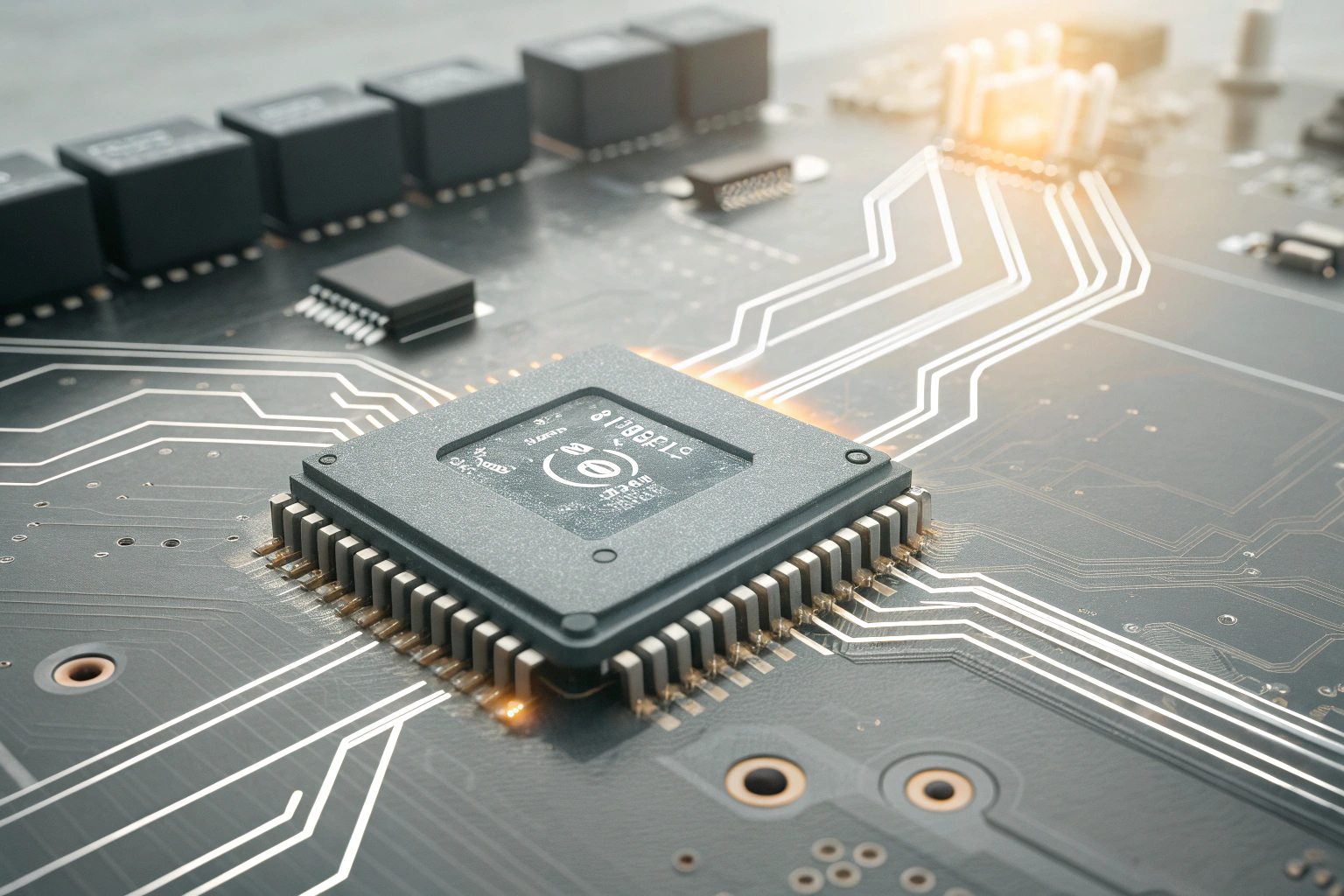
A silicon root of trust is a secure hardware foundation built directly into a chip that verifies a device’s software and firmware are authentic and untampered with. It acts as an immutable anchor, launching a secure boot process that checks each component before it loads. This fundamental security measure protects systems from low-level malware, rootkits, and physical attacks that traditional antivirus software cannot detect, ensuring device integrity from the moment it is powered on.
Key Benefits at a Glance
- Prevents Deep-Level Attacks: Blocks sophisticated threats like bootkits and firmware rootkits that infect a system before the operating system and security software even start.
- Ensures System Integrity: Verifies every piece of code from the initial bootloader onward, creating a “chain of trust” that guarantees the device is running authentic, unmodified software.
- Provides Permanent Security: Since it is burned into the hardware, it cannot be altered or bypassed by malware, offering a constant and reliable security foundation for the device’s entire lifecycle.
- Enables Secure Recovery: Allows a compromised system to be restored to a known-good state with trusted firmware, preventing attackers from maintaining persistent control after a breach.
- Supports Zero-Trust Models: Establishes a verifiable device identity, which is essential for modern security frameworks where no user or device is trusted by default.
Purpose of this guide
This guide helps IT managers, security professionals, and anyone purchasing new technology understand the critical role of hardware-based security. It solves the problem of assessing device trustworthiness beyond software features by explaining what a silicon root of trust is and why it is non-negotiable for protecting sensitive data. You will learn how this technology provides a definitive anchor for system security, how to identify devices that include it, and why relying only on software protection is a critical mistake, ensuring long-term defense against evolving cyber threats.
My Approach to Understanding Silicon Root of Trust Fundamentals
When I first encountered silicon root of trust technology fifteen years ago, I was struck by a fundamental shift happening in cybersecurity. Traditional software-based security approaches were proving inadequate against increasingly sophisticated threats, and the industry was turning to hardware as the immutable foundation for trust. A silicon root of trust represents the ultimate hardware security anchor—an unchangeable, tamper-resistant foundation built directly into semiconductor devices that establishes cryptographic trust for all subsequent system operations.
“A hardware root of trust is the foundation on which all secure operations of a computing system depend. It contains the keys used for cryptographic functions.”
— Rambus, April 2025
Source link
The concept of root of trust itself is straightforward: it's the starting point from which all other security functions derive their legitimacy. What makes silicon root of trust revolutionary is that this trust anchor is embedded directly into the hardware during manufacturing, making it virtually impossible to modify or compromise through software attacks. Unlike traditional security implementations that rely on software running on general-purpose processors, silicon root of trust operates from dedicated security processors or fixed-function hardware blocks within system-on-chip (SoC) designs.
In my implementations across various semiconductor devices, I've observed how silicon root of trust transforms the entire security paradigm. Rather than hoping software remains uncompromised, we can now establish cryptographic foundations that are physically protected and immutable. This hardware security approach provides tamper resistance that software simply cannot match—attackers cannot modify what is literally burned into silicon during fabrication.
| Aspect | Hardware Root of Trust | Software-Only Security |
|---|---|---|
| Immutability | Fixed in silicon, cannot be modified | Can be altered by malware or attacks |
| Tamper Resistance | Physical protection against manipulation | Vulnerable to memory corruption |
| Boot Security | Hardware-verified secure boot | Software-based verification only |
| Attack Surface | Minimal, isolated hardware | Large, exposed to system threats |
| Performance | Dedicated crypto acceleration | CPU-dependent processing |
The secure boot process exemplifies how silicon root of trust establishes security from the very first instruction executed. When a system powers on, the immutable hardware validates the initial firmware before allowing execution, creating a chain of trust that extends through the entire boot sequence. This hardware-based verification cannot be bypassed or corrupted because the verification logic itself is part of the silicon.
- Silicon root of trust provides immutable hardware-based security foundation
- Hardware implementation offers superior tamper resistance compared to software
- Trust propagates from hardware to software layers through cryptographic verification
- Dedicated security processors enable both protection and performance benefits
How I've Witnessed the Evolution of Hardware Security
My journey through hardware security evolution began with discrete secure elements—dedicated chips that provided isolated cryptographic functions. These early implementations, while effective, required additional components and complex integration. The progression to Trusted Platform Module (TPM) technology marked a significant advancement, providing standardized hardware security modules that could be integrated into various platforms.
The introduction of Trusted Execution Environments (TEE) represented another evolutionary step, creating secure software enclaves within general-purpose processors. However, these solutions still relied on complex software stacks and remained vulnerable to certain classes of attacks. Hardware Security Modules (HSM) provided enterprise-grade protection but at significant cost and complexity.
What I've observed is that each generation addressed specific limitations of its predecessors, ultimately leading to the integrated silicon root of trust approach we see today. Modern implementations embed security directly into the primary SoC, eliminating the need for separate security chips while providing superior protection. This evolution reflects the industry's recognition that security cannot be an afterthought—it must be foundational.
The transition from discrete security components to integrated silicon solutions has been driven by both security requirements and practical constraints. IoT devices, for example, cannot accommodate separate security chips due to size and cost limitations, making integrated silicon root of trust essential for securing the expanding Internet of Things.
Why I Believe Hardware-Based Trust Matters
Hardware security fundamentally changes the threat landscape by moving critical security functions below the software layer where most attacks occur. When I implement hardware security solutions, I'm creating a foundation that cannot be compromised through traditional software exploitation techniques. The immutability of hardware-based trust means that even if an attacker gains complete control of the operating system, they cannot modify the underlying security foundation.
Firmware integrity represents one of the most critical advantages of hardware-based trust. In my secure boot implementations, the silicon root of trust validates firmware signatures using cryptographic keys that are permanently stored in hardware. This creates an unbreakable chain of verification that ensures only authorized code executes on the system. Unlike software-based verification, this process cannot be bypassed or corrupted because the verification logic is part of the silicon itself.
Tamper resistance provides another crucial advantage that software simply cannot match. Hardware-based security can detect and respond to physical attacks, environmental manipulation, and fault injection attempts. In my designs, I've incorporated sensors that monitor voltage, temperature, and electromagnetic signatures to detect tampering attempts. When suspicious activity is detected, the hardware can immediately disable critical functions or erase sensitive data.
The cybersecurity threat landscape continues to evolve, with attackers developing increasingly sophisticated techniques to compromise software-based security. Hardware-based trust provides a stable foundation that remains effective against these evolving threats. Even as new attack vectors emerge, the immutable nature of silicon root of trust ensures that core security functions remain protected.
Performance benefits also distinguish hardware security from software alternatives. Dedicated cryptographic accelerators within silicon root of trust implementations can perform encryption, digital signature verification, and key operations orders of magnitude faster than software implementations. This performance advantage becomes critical in applications requiring real-time security operations or high-throughput cryptographic processing.
Types of Silicon-Based Hardware Root of Trust I've Implemented
Throughout my career implementing silicon root of trust solutions, I've worked with two fundamental architectural approaches: fixed function and programmable implementations. Each approach offers distinct advantages depending on the specific security requirements, power constraints, and flexibility needs of the target application.
| Attribute | Fixed Function RoT | Programmable RoT |
|---|---|---|
| Security Level | Highest (immutable) | High (updateable) |
| Flexibility | Limited to designed functions | Adaptable to new requirements |
| Power Consumption | Minimal | Moderate |
| Cost | Lower | Higher |
| Update Capability | None | Firmware updates possible |
| Suitable Applications | IoT, embedded systems | Servers, complex systems |
The choice between fixed function and programmable silicon root of trust fundamentally depends on the balance between security, flexibility, and resource constraints. In my experience, IoT applications typically favor fixed function implementations due to their power efficiency and lower cost, while enterprise systems often require the adaptability that programmable implementations provide.
CPU integration represents another critical architectural decision. Some implementations integrate root of trust functions directly into the main processor, while others use dedicated security processors. The integrated approach offers better performance and lower cost, but dedicated security processors provide superior isolation and tamper resistance.
Firmware-controlled root of trust implementations bridge the gap between fixed and fully programmable approaches. These solutions use immutable hardware for core security functions while allowing firmware updates for higher-level security policies and protocols. This hybrid approach often provides the optimal balance of security and flexibility for complex systems.
Fixed Function Silicon Root of Trust: My Implementation Experience
Fixed function silicon root of trust implementations represent the most secure approach to hardware-based security, with all critical functions permanently embedded in silicon during manufacturing. In my IoT device implementations, I've found these solutions provide unmatched security for applications where the security requirements are well-defined and unlikely to change throughout the product lifecycle.
The immutability of fixed function implementations creates the highest possible security level because there is literally no mechanism to modify the security functions after manufacturing. When I designed security for a smart meter deployment, the fixed function approach was essential because these devices would operate in the field for decades without any possibility of physical access or maintenance. The hardware acceleration capabilities built into these implementations typically provide excellent performance for standard cryptographic operations while consuming minimal power.
Power-constrained devices particularly benefit from fixed function implementations. In my experience with battery-powered IoT sensors, the dedicated hardware performs cryptographic operations with significantly lower power consumption than general-purpose processors running security software. The streamlined hardware design eliminates unnecessary complexity, resulting in both power efficiency and cost advantages.
However, the limitations of fixed function implementations became apparent in a project where new security requirements emerged after deployment. The inability to adapt to new cryptographic standards or threat responses meant that devices required hardware replacement rather than software updates. This experience taught me the importance of carefully evaluating long-term security requirements before committing to fixed function implementations.
IoT devices represent the ideal application domain for fixed function silicon root of trust. The constrained resources, long deployment lifecycles, and well-defined security requirements make immutable hardware security both practical and desirable. In my smart city sensor deployments, fixed function implementations provided robust security while meeting strict power and cost budgets.
My Approach to Programmable Silicon Root of Trust
Programmable silicon root of trust implementations offer the flexibility to adapt security functions through firmware updates while maintaining hardware-based protection for core security elements. In my enterprise server implementations, this adaptability has proven essential for responding to evolving threats and changing security requirements.
The key advantage of programmable implementations lies in their ability to evolve. When new cryptographic algorithms become available or vulnerabilities are discovered in existing protocols, firmware updates can implement necessary changes without hardware modifications. I experienced this firsthand when implementing post-quantum cryptography support—programmable implementations allowed field updates to new algorithms as standards were finalized.
Security processors within programmable implementations typically provide dedicated execution environments for security firmware, maintaining isolation from the main system while enabling updates. The challenge lies in ensuring that the update mechanism itself remains secure and cannot be exploited to compromise the root of trust. In my designs, I implement cryptographically verified update processes with rollback protection to maintain security integrity.
Cryptographic algorithms represent a particular strength of programmable implementations. Rather than being limited to a fixed set of algorithms embedded in hardware, these systems can implement new cryptographic methods as they become available. This flexibility proved invaluable when migrating from SHA-1 to SHA-256 and preparing for post-quantum cryptography transitions.
The complexity of programmable implementations requires careful architectural design to maintain security while enabling flexibility. I've learned that the most effective approach involves using immutable hardware for core functions like secure boot and key storage, while allowing programmability for higher-level security protocols and policies. This hybrid approach provides the security benefits of fixed hardware with the adaptability needed for long-term deployments.
Core Security Functions I've Implemented with Silicon Root of Trust
Silicon root of trust enables a comprehensive suite of security functions that form the foundation for system-wide protection. Through my implementations across various platforms, I've identified six core functions that consistently provide the greatest security value: secure boot, key management, secure storage, authentication, attestation, and cryptographic acceleration.
- Secure Boot – Verifies firmware integrity during system startup
- Key Management – Protects and manages cryptographic keys in hardware
- Secure Storage – Provides tamper-resistant data protection
- Authentication – Establishes device and user identity verification
- Attestation – Enables remote verification of platform integrity
- Cryptographic Operations – Accelerates encryption and digital signatures
These functions work synergistically to create a comprehensive security framework. Secure boot establishes initial trust, key management protects the cryptographic foundation, and attestation enables ongoing verification of system integrity. The integration of these functions within silicon hardware provides performance advantages while maintaining the highest levels of security.
The implementation of these core functions varies significantly based on the target application and security requirements. IoT devices might implement a minimal subset focused on secure boot and basic authentication, while enterprise servers require the full spectrum of capabilities including advanced attestation and high-performance cryptographic operations.
My Approach to Secure Boot and Chain of Trust
Secure boot represents the most fundamental security function provided by silicon root of trust, establishing trust from the very first instruction executed during system startup. In my implementations, the chain of trust begins with immutable code stored in the silicon root of trust that verifies the integrity of the next stage in the boot process.
The chain begins with immutable boot code and extends through every firmware layer—a model I detail further in the context of secure firmware, where cryptographic validation prevents unauthorized code execution from the earliest boot stage.
The chain of trust concept ensures that each stage of the boot process verifies the integrity of the subsequent stage before transferring control. This creates an unbreakable sequence of verification that extends from the hardware root through the firmware, bootloader, operating system, and ultimately to the applications. If any component in this chain fails verification, the boot process halts, preventing compromised code from executing.
Digital signatures provide the cryptographic foundation for secure boot verification. Each component in the boot chain is signed with a private key corresponding to a public key stored in the hardware root of trust. During boot, the hardware verifies these signatures using its immutable public keys, ensuring that only authorized code executes. The use of cryptographic verification makes it computationally infeasible for attackers to create valid signatures for malicious code.
Code verification extends beyond simple signature checking to include comprehensive integrity validation. In my implementations, I verify not only the cryptographic signatures but also hash values, version numbers, and security policies. This multi-layered verification approach ensures that even subtle modifications to authorized code are detected and prevented.
Trusted execution begins with secure boot and extends throughout system operation. Once the chain of trust is established during boot, the silicon root of trust continues to monitor system integrity and can respond to runtime attacks. This ongoing protection ensures that the security established during boot is maintained throughout the system lifecycle.
How I Implement Secure Storage and Key Management
Secure storage and key management represent the cryptographic heart of silicon root of trust implementations. The protection of cryptographic keys determines the security of all other functions, making this one of the most critical aspects of any hardware security implementation.
Cryptographic keys require protection that goes far beyond simple access controls. In my implementations, keys are stored in dedicated hardware security modules within the silicon root of trust that provide both logical and physical protection. These modules use specialized memory technologies that resist both invasive and non-invasive attacks, ensuring that keys remain secure even under sophisticated physical analysis.
Key management encompasses the entire lifecycle of cryptographic keys, from generation through destruction. The silicon root of trust provides hardware-based random number generation for key creation, secure storage for key protection, and controlled access for key usage. Importantly, keys can be generated within the hardware and never exposed in plaintext, eliminating many potential attack vectors.
Physical Unclonable Functions (PUFs) represent an advanced approach to key derivation that I've implemented in several projects. PUFs use the unique physical characteristics of each silicon chip to derive cryptographic keys, creating device-specific keys that cannot be duplicated or extracted. This approach eliminates the need to store keys in non-volatile memory, reducing the attack surface significantly.
Key derivation techniques allow a single master key to generate multiple application-specific keys through cryptographic derivation functions. In my implementations, the silicon root of trust stores a minimal number of master keys and derives all other keys as needed. This approach reduces the amount of sensitive data that must be permanently stored while providing flexibility for different applications and protocols.
Cryptographic boundaries within the silicon root of trust ensure that keys remain isolated from both software and other hardware components. These boundaries are enforced through a combination of hardware access controls, memory protection, and logical isolation that prevents unauthorized access to sensitive key material.
My Techniques for Authentication and Attestation
Authentication and attestation functions enable silicon root of trust to establish and verify identity at both the device and platform levels. These capabilities are essential for creating trust relationships in distributed systems and enabling secure communication between devices.
Device identity stems from unique characteristics embedded in the silicon during manufacturing. In my implementations, I use a combination of device-specific keys, certificates, and identifiers that create unforgeable device identities. These identities are anchored in hardware, making them resistant to cloning or spoofing attacks that plague software-based identity systems.
Remote attestation enables distant systems to verify the integrity and authenticity of a device or platform. The silicon root of trust generates cryptographic attestations that prove the device's identity, firmware integrity, and security configuration. These attestations can be verified by remote systems without requiring direct access to the device, enabling secure authentication across networks.
Secure authentication protocols leverage the cryptographic capabilities of silicon root of trust to implement strong authentication mechanisms. Rather than relying on passwords or other weak authentication factors, these systems use cryptographic challenges and responses that prove possession of hardware-protected keys. The authentication process cannot be replayed or forged because it relies on cryptographic operations that can only be performed by the authentic device.
Trusted verification of attestations requires a robust public key infrastructure that can validate the cryptographic chains linking device identities to trusted authorities. In my implementations, I establish certificate hierarchies that allow remote systems to verify device attestations without requiring direct relationships with individual devices.
Secure Communication and Cryptographic Acceleration in My Designs
Secure communication functions within silicon root of trust provide both security and performance advantages for network protocols and data protection. The integration of cryptographic acceleration directly into the hardware security module enables high-performance secure communication without compromising security.
Encryption operations benefit significantly from hardware acceleration, particularly for algorithms like AES that are well-suited to dedicated hardware implementation. In my designs, I've achieved encryption throughput improvements of 10-100x compared to software implementations while reducing power consumption and CPU overhead.
Cryptographic acceleration extends beyond simple encryption to include digital signature generation and verification, hash computation, and key exchange protocols. The silicon root of trust can implement these operations using dedicated hardware that is both faster and more secure than software alternatives.
Secure communication protocols like TLS benefit from hardware-accelerated cryptographic operations throughout the connection establishment and data transfer phases. The silicon root of trust can perform the computationally intensive operations required for perfect forward secrecy and authentication while maintaining the security properties necessary for trusted communication.
Hardware crypto implementations provide resistance against timing attacks and other side-channel attacks that can compromise software implementations. The dedicated hardware design can implement countermeasures like constant-time operations and power analysis resistance that are difficult to achieve in software.
Performance optimization in my designs focuses on balancing security and throughput requirements. While maximum security often requires additional computational overhead, careful implementation can achieve both security and performance goals through efficient hardware design and algorithm selection.
My Approach to Secure Update Mechanisms
Secure update mechanisms represent one of the most challenging aspects of silicon root of trust implementation, requiring the ability to modify system software while maintaining security guarantees. The update process must be both secure and reliable, ensuring that only authorized updates are installed while preventing system failures that could brick devices.
Firmware updates require cryptographic verification to ensure authenticity and integrity. In my implementations, updates are signed with keys corresponding to certificates stored in the silicon root of trust. The update process verifies these signatures before installation, preventing unauthorized modifications to system firmware.
Software updates extend the secure update concept to application software and operating system components. While these updates may not be verified directly by the silicon root of trust, the secure boot process ensures that only properly signed software executes, creating a comprehensive update security framework.
Rollback protection prevents attackers from downgrading systems to versions with known vulnerabilities. The silicon root of trust maintains version information in tamper-resistant storage and refuses to boot older firmware versions. This protection is essential for maintaining security in the face of sophisticated attacks that might attempt to exploit patched vulnerabilities.
Update verification encompasses multiple layers of checking beyond simple signature verification. I implement comprehensive validation that includes version checking, compatibility verification, and integrity testing to ensure that updates are not only authentic but also appropriate for the target system.
How I Implement Secure Debug Features
Secure debug features present a fundamental tension between security and troubleshooting capabilities. Development and manufacturing require extensive debug access, while deployed systems must restrict this access to prevent security compromises. Silicon root of trust implementations must carefully balance these competing requirements.
Debug interfaces in silicon root of trust systems typically include JTAG, debug ports, and trace capabilities that are essential for development and manufacturing. However, these interfaces can also provide attackers with powerful tools for system analysis and attack. Secure implementation requires authentication and authorization mechanisms that control debug access based on device lifecycle and security policies.
Secure debug mechanisms implement graduated access controls that provide different levels of debug capability based on authentication credentials and device state. During development, full debug access may be available with appropriate authentication, while production devices might disable debug interfaces entirely or require cryptographic authentication for any access.
Debug authentication typically uses cryptographic challenges that prove possession of appropriate credentials before enabling debug functionality. In my implementations, I use device-specific challenge-response protocols that prevent replay attacks and ensure that debug access cannot be enabled without proper authorization.
The lifecycle management of debug capabilities represents a critical security consideration. Debug access that is appropriate during development becomes a security vulnerability in deployed systems. Effective implementations provide mechanisms for permanently disabling debug interfaces or transitioning to more restrictive debug modes as devices move through their lifecycle stages.
Implementation Considerations and Best Practices I've Developed
Successful silicon root of trust implementation requires careful attention to architectural design, security boundaries, and practical constraints. Through my experience with numerous deployments, I've developed a comprehensive approach that addresses both security requirements and real-world implementation challenges.
- Define comprehensive threat model and security requirements
- Implement proper isolation between trusted and untrusted components
- Design defense-in-depth architecture with multiple security layers
- Integrate side-channel attack countermeasures from the start
- Plan for secure update mechanisms and rollback protection
- Validate implementation through security testing and certification
- Establish secure manufacturing and supply chain processes
Security architecture decisions made early in the design process fundamentally determine the effectiveness of the final implementation. I've learned that retrofitting security into existing designs is far more difficult and less effective than incorporating security principles from the beginning. The architecture must clearly define trust boundaries, isolation mechanisms, and security policies that will govern system operation.
Defense in depth principles ensure that no single security mechanism represents a single point of failure. In my implementations, I layer multiple independent security mechanisms so that the compromise of any single element does not compromise overall system security. This approach provides resilience against both known and unknown attack vectors.
Physical security considerations extend beyond the silicon itself to include the entire system architecture and deployment environment. While silicon root of trust provides strong protection against many attacks, the overall system security depends on proper integration and deployment practices.
Physical and Logical Isolation Techniques I Recommend
Isolation represents the fundamental principle underlying effective silicon root of trust implementation. Both physical and logical isolation mechanisms are necessary to create secure boundaries that prevent unauthorized access to sensitive functions and data.
Security boundaries within silicon implementations must be clearly defined and rigorously enforced. In my designs, I establish multiple levels of security boundaries, from the highest-level separation between trusted and untrusted components down to fine-grained access controls for individual cryptographic operations.
Logical isolation techniques include memory protection, access controls, and privilege separation that prevent software components from interfering with each other. The silicon root of trust typically operates at the highest privilege level with access to all security functions, while application software operates in restricted environments with limited capabilities.
Physical separation within silicon designs involves dedicating specific hardware resources exclusively to security functions. This separation prevents side-channel attacks that might otherwise allow unauthorized components to observe or influence security operations. Dedicated security processors, isolated memory regions, and separate clock domains all contribute to effective physical separation.
Privilege levels within the system architecture ensure that only authorized components can access security functions. The silicon root of trust operates with maximum privileges, while other system components operate with the minimum privileges necessary for their functions. This privilege separation limits the impact of compromises in non-security components.
How I Counter Physical and Side-Channel Attacks
Physical and side-channel attacks represent sophisticated threats that target the hardware implementation itself rather than software vulnerabilities. These attacks require specialized countermeasures that must be integrated into the silicon design from the beginning.
Side-channel attacks exploit information leaked through power consumption, electromagnetic emissions, timing variations, or other observable characteristics of hardware operation. In my implementations, I use a combination of masking, hiding, and randomization techniques to minimize information leakage and make side-channel analysis infeasible.
Fault injection attacks attempt to disrupt normal hardware operation to bypass security mechanisms or extract sensitive information. Protection against these attacks requires monitoring circuits that detect abnormal operating conditions and respond by disabling security functions or erasing sensitive data.
Simple Power Analysis (SPA) attacks observe power consumption patterns to infer information about cryptographic operations. Countermeasures include power consumption randomization, dummy operations, and algorithm implementations that maintain constant power consumption regardless of the data being processed.
Differential Power Analysis (DPA) attacks use statistical analysis of power consumption across multiple operations to extract cryptographic keys. Protection requires masking techniques that randomize intermediate values and decorrelation methods that break the statistical relationship between power consumption and sensitive data.
Fault Injection Attacks (FIA) use voltage glitching, clock manipulation, or other techniques to induce computational errors that can be exploited to bypass security checks or extract information. Effective countermeasures include error detection and correction, redundant computation, and secure failure modes that prevent exploitation of induced faults.
Certification and Compliance: My Experience Navigating Requirements
Certification and compliance requirements significantly influence silicon root of trust implementation decisions and must be considered from the earliest design stages. My experience with various certification programs has taught me that achieving certification requires careful planning and documentation throughout the development process.
FIPS 140-3 represents the most widely recognized standard for cryptographic modules and provides a comprehensive framework for evaluating hardware security implementations. The standard defines four security levels with progressively more stringent requirements for physical security, authentication, and key management. In my experience, achieving FIPS 140-3 Level 3 or 4 certification requires extensive documentation and testing but provides strong validation of security implementation quality.
Common Criteria provides an international framework for security evaluation that can be tailored to specific application requirements. While more flexible than FIPS 140-3, Common Criteria evaluations require detailed security targets and extensive evidence to demonstrate that implementations meet their security claims.
ISO certifications encompass various aspects of security management and implementation. ISO 15408 provides the foundation for Common Criteria evaluations, while other ISO standards address specific industry requirements or security practices. Compliance with these standards often requires organizational processes and documentation beyond the technical implementation itself.
Industry-specific standards like ISO 26262 for automotive functional safety and ISO 21434 for automotive cybersecurity add additional requirements that must be integrated with silicon root of trust implementations. These standards often require safety analysis and hazard assessment that complement security evaluation.
The certification process itself requires significant time and resources, often extending the development timeline by months or years. However, the discipline required for certification often improves the overall quality of the implementation and provides valuable validation of security properties.
My Design Approach to Siloed Execution and Resource Separation
Siloed execution and resource separation represent advanced isolation techniques that provide the strongest possible protection for security-critical operations. These approaches create independent execution environments that cannot interfere with each other even in the presence of sophisticated attacks.
Siloed hardware security involves dedicating specific hardware resources exclusively to security functions, creating physical isolation that cannot be bypassed through software attacks. In my implementations, I use separate processors, memory regions, and communication channels for security operations, ensuring that compromises in non-security components cannot affect security functions.
Security domains provide logical separation that complements physical isolation by defining clear boundaries between different security levels and functions. Each security domain operates with its own policies, keys, and access controls, preventing cross-domain attacks and limiting the impact of any single compromise.
Hardware resource isolation ensures that security functions have dedicated access to necessary resources without interference from other system components. This isolation extends to computational resources, memory bandwidth, and input/output capabilities, preventing denial-of-service attacks that might otherwise disrupt security operations.
The implementation of siloed execution requires careful consideration of communication mechanisms between security domains. While isolation is essential for security, practical systems require controlled communication channels that allow security functions to provide services to other system components without compromising isolation properties.
Emerging Trends and Future Directions I'm Watching
The silicon root of trust landscape continues to evolve rapidly, driven by emerging threats, new technologies, and changing security requirements. My analysis of current trends suggests several key areas that will significantly impact future implementations.
“Today at the Open Compute Project Global Summit, we introduced Caliptra 2.1, an open-source silicon Root of Trust (RoT) security subsystem designed for seamless integration into secure devices.”
— Microsoft Tech Community, December 2024
Source link
Quantum computing represents both a threat and an opportunity for silicon root of trust implementations. While quantum computers threaten current cryptographic algorithms, they also enable new forms of quantum-safe cryptography that can provide even stronger security guarantees. The transition to post-quantum cryptography will require careful planning and implementation to maintain security during the migration period.
Post-quantum cryptography standards are rapidly maturing, with NIST having standardized several algorithms that are suitable for hardware implementation. These new algorithms have different performance characteristics and implementation requirements compared to current cryptographic methods, requiring updates to silicon root of trust architectures.
Quantum-safe cryptography encompasses not only post-quantum algorithms but also quantum key distribution and other quantum technologies that can enhance security. While these technologies are still emerging, they represent potential future directions for the most security-critical applications.
Zero-trust architecture principles are increasingly being applied to silicon root of trust implementations, requiring continuous verification and authentication rather than relying on initial trust establishment. This approach requires more sophisticated attestation and monitoring capabilities within the hardware security implementation.
My Work with Quantum-Safe Root of Trust Implementations
Quantum-safe root of trust implementations represent one of the most significant challenges facing the hardware security industry. The threat of quantum computers capable of breaking current cryptographic algorithms requires a fundamental transition to new post-quantum algorithms that remain secure against both classical and quantum attacks.
| Algorithm | Type | Key Size | Hardware Suitability |
|---|---|---|---|
| CRYSTALS-Kyber | Key Encapsulation | Medium | Good |
| CRYSTALS-Dilithium | Digital Signature | Large | Moderate |
| XMSS | Hash-based Signature | Small | Excellent |
| LMS | Hash-based Signature | Small | Excellent |
NIST has played a crucial role in standardizing post-quantum cryptographic algorithms through its Post-Quantum Cryptography Standardization process. The selected algorithms represent the best current understanding of quantum-resistant cryptography, though the field continues to evolve as researchers develop new attacks and defenses.
CNSA Quantum-Resistant Algorithms provide guidance for government and critical infrastructure applications, emphasizing the need for cryptographic agility and migration planning. These recommendations influence commercial implementations and provide a roadmap for quantum-safe transitions.
CRYSTALS-Kyber provides quantum-safe key encapsulation with reasonable performance characteristics for hardware implementation. My evaluation of this algorithm suggests it can be effectively implemented in silicon root of trust systems with moderate increases in computational and storage requirements.
CRYSTALS-Dilithium offers quantum-safe digital signatures but with significantly larger signature sizes than current algorithms. The implementation challenges include managing the increased storage requirements and computational complexity while maintaining performance.
Hash-based signature algorithms like XMSS and LMS provide excellent quantum resistance with relatively simple hardware implementation requirements. These algorithms are particularly well-suited to silicon root of trust applications where signature generation frequency is limited and strong security guarantees are essential.
My Vision for Integration with AI and Machine Learning
AI and machine learning technologies offer significant potential for enhancing silicon root of trust capabilities, particularly in the areas of threat detection, anomaly analysis, and adaptive security responses. However, the integration of AI with hardware security systems requires careful consideration of both security and performance implications.
Anomaly detection represents one of the most promising applications of machine learning in silicon root of trust systems. By analyzing patterns of system behavior, AI algorithms can identify deviations that might indicate attacks or security compromises. The challenge lies in implementing these algorithms efficiently within the resource constraints of hardware security modules.
Machine learning algorithms can enhance behavioral analysis capabilities by learning normal patterns of operation and identifying suspicious activities that might not trigger traditional rule-based detection systems. This approach is particularly valuable for detecting sophisticated attacks that attempt to mimic normal behavior.
AI-enhanced security can provide adaptive threat response capabilities that automatically adjust security policies and countermeasures based on detected threat patterns. This adaptability could significantly improve the effectiveness of silicon root of trust systems against evolving attack techniques.
The integration of AI and silicon root of trust requires careful consideration of the security implications of the AI algorithms themselves. Machine learning models can be vulnerable to adversarial attacks that attempt to manipulate their behavior, requiring additional security measures to protect the integrity of AI-enhanced security systems.
Real-World Applications: Case Studies from My Experience
Silicon root of trust technology has found applications across diverse industries and use cases, each presenting unique challenges and requirements. My experience implementing these solutions has provided insights into the practical considerations and trade-offs involved in real-world deployments.
Silicon Root of Trust establishes a tamper-resistant hardware foundation for secure boot, key storage, and authentication in SoCs and devices. For detailed implementation, explore open source designs. HPE’s approach integrates it into server iLO chips for immutable firmware validation. Learn about firmware protection in enterprise hardware.
Security implementation approaches vary significantly based on the target application domain, available resources, and threat model. IoT devices typically require minimal, power-efficient implementations, while enterprise servers demand comprehensive security features with high performance. Understanding these application-specific requirements is essential for successful deployment.
Industry applications span from consumer electronics to critical infrastructure, each with distinct regulatory requirements, security standards, and operational constraints. The flexibility of silicon root of trust technology enables tailored implementations that address specific industry needs while maintaining core security principles.
Deployment scenarios range from high-volume consumer products to specialized industrial applications, requiring different approaches to manufacturing, certification, and lifecycle management. Successful implementations must consider the entire product lifecycle from initial development through end-of-life disposal.
How I've Secured IoT and Edge Computing Devices
IoT and edge computing applications present unique challenges for silicon root of trust implementation, combining strict resource constraints with demanding security requirements. The distributed nature of IoT deployments and the difficulty of providing updates or maintenance make hardware-based security essential.
IoT devices typically operate under severe power, cost, and size constraints that limit the complexity of security implementations. In my smart sensor deployments, I've found that fixed-function silicon root of trust provides the optimal balance of security and efficiency for battery-powered devices that must operate for years without maintenance.
Device attestation becomes particularly important in IoT applications where devices operate autonomously and must establish trust relationships without human intervention. The silicon root of trust provides unique device identities and cryptographic capabilities that enable secure authentication and authorization in distributed IoT networks.
Edge computing applications require more sophisticated security capabilities to protect sensitive data processing at network edges. The silicon root of trust provides secure execution environments for edge AI applications and ensures that sensitive algorithms and data remain protected even when devices are physically accessible to attackers.
Secure connectivity represents a major challenge for IoT devices that must communicate over potentially hostile networks. Silicon root of trust implementations provide hardware-accelerated cryptographic operations that enable efficient implementation of secure communication protocols without overwhelming limited computational resources.
The scalability of IoT security solutions requires careful consideration of key management and certificate provisioning at manufacturing scale. My experience with million-device deployments has taught me the importance of automated provisioning systems and hierarchical trust architectures that can scale to support massive IoT deployments.
My Experience Securing Cloud and Data Center Infrastructure
Cloud and data center applications represent the other extreme of silicon root of trust implementation, requiring maximum security capabilities and high performance to protect valuable data and services. These applications typically have sufficient resources to implement comprehensive security features while demanding the highest levels of assurance.
Server security in cloud environments faces sophisticated threats from both external attackers and malicious insiders with physical access to hardware. Silicon root of trust provides hardware-based protection that remains effective even when attackers have physical access to servers, protecting against firmware modification and hardware tampering.
Supply chain integrity represents a critical concern for cloud and data center operators who must trust hardware from multiple vendors. Silicon root of trust implementations provide cryptographic attestation of hardware authenticity and firmware integrity, enabling detection of counterfeit or modified components.
Firmware protection through silicon root of trust ensures that server firmware cannot be modified by attackers, even those with administrative access to the operating system. This protection is essential for maintaining trust in cloud infrastructure where customers rely on the service provider to protect their data and applications.
Cloud infrastructure security benefits from the performance capabilities of silicon root of trust implementations, which can provide hardware-accelerated cryptographic operations for encryption, authentication, and integrity verification at scale. These performance benefits enable strong security without impacting application performance.
Trusted compute environments created by silicon root of trust enable cloud providers to offer strong security guarantees to customers, including protection against malicious administrators and hardware-based isolation between different customers' workloads.
My Work in Automotive and Critical Infrastructure Security
Automotive and critical infrastructure applications present unique challenges that combine safety requirements with security needs, requiring silicon root of trust implementations that can provide both functional safety and cybersecurity protection.
In automotive deployments, the root of trust must coexist with ASIL-compliant logic—something I align with standards like ASIL-D requirements to ensure both security and functional safety are satisfied.
Automotive security has become increasingly important as vehicles incorporate more connected and autonomous features that create new attack surfaces. Silicon root of trust provides the hardware security foundation necessary to protect critical vehicle systems from cyber attacks that could compromise safety.
Critical infrastructure protection requires security implementations that can maintain operation even under sophisticated nation-state attacks. The immutable nature of silicon root of trust provides strong protection against persistent threats that might otherwise compromise software-based security systems.
Functional safety requirements in automotive applications demand that security implementations do not interfere with safety-critical functions. My experience with ISO 26262 compliance has taught me the importance of designing security systems that enhance rather than compromise functional safety.
Over-the-air updates represent both a security challenge and an opportunity for automotive applications. Silicon root of trust enables secure update mechanisms that can protect against malicious firmware while enabling necessary security and functionality updates throughout the vehicle lifecycle.
Vehicle-to-Vehicle (V2X) communication requires strong authentication and encryption to prevent spoofing and eavesdropping attacks that could compromise traffic safety. Silicon root of trust provides the cryptographic capabilities necessary to implement secure V2X protocols at automotive scale.
Advanced Driver-Assistance Systems (ADAS) rely on sensor data and algorithms that must be protected from tampering to ensure safe operation. Silicon root of trust can provide secure execution environments that protect ADAS algorithms and verify the integrity of sensor data.
How I Select the Right Silicon Root of Trust for Different Applications
Selecting the appropriate silicon root of trust implementation requires a systematic evaluation process that considers security requirements, performance constraints, and practical implementation factors. My approach emphasizes risk-based decision making that aligns security investments with actual threats and business requirements.
- What are the specific security threats and attack vectors for your application?
- What level of tamper resistance and physical security is required?
- Do you need fixed function security or programmable flexibility?
- What are the power consumption and performance constraints?
- What certification requirements must be met (FIPS, Common Criteria)?
- How will secure updates be managed throughout the product lifecycle?
- What is the acceptable cost and complexity for implementation?
- How will the solution integrate with existing system architecture?
Risk assessment forms the foundation of the selection process, identifying the specific threats that the silicon root of trust must address. Different applications face different threat models, requiring tailored security implementations that provide appropriate protection without unnecessary complexity or cost.
Requirements analysis must consider both functional and non-functional requirements, including security capabilities, performance requirements, power constraints, and certification needs. The selection process must balance these often-competing requirements to identify optimal solutions.
Security evaluation involves assessing the effectiveness of different implementation approaches against the identified threats and requirements. This evaluation must consider both the theoretical security properties and the practical implementation challenges that might affect real-world security.
My Method for Defining Security Requirements and Threat Models
Threat modeling provides the foundation for all security design decisions by systematically identifying the threats that a system must address. My approach to threat modeling combines industry-standard methodologies with practical experience to create comprehensive threat models that guide implementation decisions.
Attack vectors must be carefully analyzed to understand how adversaries might attempt to compromise the system. This analysis includes both technical attack methods and the capabilities and motivations of potential attackers, ranging from opportunistic criminals to sophisticated nation-state actors.
Security requirements derive directly from the threat model and define the specific security properties that the implementation must provide. These requirements must be measurable and testable to enable verification that the implementation meets its security objectives.
Vulnerability analysis identifies potential weaknesses in the proposed implementation that might be exploited by attackers. This analysis must consider both known vulnerabilities in similar systems and potential new attack vectors that might emerge as the technology evolves.
The iterative nature of threat modeling requires regular updates as new threats emerge and the system evolves. My experience has shown that threat models developed early in the design process require regular revision to remain relevant and effective.
How I Balance Security, Performance, and Cost
Balancing security, performance, and cost represents one of the most challenging aspects of silicon root of trust implementation. These three factors often conflict, requiring careful tradeoff analysis to identify optimal solutions that meet all requirements within acceptable constraints.
- Start with minimum viable security and scale based on risk assessment
- Consider total cost of ownership including certification and maintenance
- Benchmark performance impact early in the design phase
- Plan for security upgrades and future threat evolution
- Evaluate vendor ecosystem and long-term support commitments
Security tradeoffs must be evaluated carefully to ensure that cost and performance optimizations do not compromise essential security properties. My approach prioritizes security requirements based on risk assessment, ensuring that the most critical threats are addressed even when resources are limited.
Performance overhead from security implementations can significantly impact system performance and user experience. Early benchmarking and performance analysis help identify potential bottlenecks and guide optimization efforts to minimize performance impact while maintaining security effectiveness.
Implementation cost includes not only the direct hardware costs but also development effort, certification expenses, and ongoing maintenance requirements. Total cost of ownership analysis provides a more accurate picture of the true cost implications of different implementation approaches.
Return on investment calculations help justify security investments by quantifying the potential costs of security breaches and comparing them to the costs of prevention. These calculations must consider both direct financial impacts and indirect costs such as reputation damage and regulatory penalties.
Risk mitigation strategies provide alternatives to expensive security implementations by reducing the likelihood or impact of successful attacks through other means. These strategies might include operational controls, environmental protections, or architectural changes that reduce security requirements.
Frequently Asked Questions
A silicon root of trust is a hardware-based security foundation embedded directly into a device’s silicon chip, serving as the ultimate trusted component for verifying the integrity of software and hardware. It ensures that all subsequent security operations, such as booting and encryption, stem from an uncompromised base. This technology is crucial for protecting against advanced threats in modern computing environments.
A hardware root of trust is a secure, tamper-resistant component in a system that provides a foundation for trusted computing by anchoring security functions like authentication and encryption. Unlike software-based solutions, it operates at the hardware level to resist attacks that could compromise higher layers. It’s essential for establishing chain-of-trust mechanisms in devices ranging from servers to IoT hardware.
Silicon-based hardware roots of trust typically include fixed-function types, which are hardwired for specific security tasks, and programmable types that allow customization via firmware. Other variations encompass discrete chips like TPMs integrated into silicon or embedded roots within SoCs for broader system protection. Each type balances security, flexibility, and performance based on application needs.
Silicon root of trust protects against supply chain attacks by verifying the authenticity and integrity of hardware and firmware from the manufacturing stage through deployment, using cryptographic signatures. It detects tampering or insertions of malicious components by establishing a secure boot process that only allows trusted code to execute. This proactive approach ensures systems remain secure even if vulnerabilities are introduced early in the supply chain.
A programmable hardware root of trust should offer features like secure key storage, cryptographic acceleration, and flexible firmware updates to adapt to evolving threats. It must include tamper detection mechanisms and support for secure boot processes to maintain system integrity. Additionally, integration with zero-trust architectures and compliance with standards like NIST enhances its effectiveness in diverse environments.
Secure Boot works with a root of trust by using it as the anchor to cryptographically verify each stage of the boot process, ensuring only authorized firmware and software load. The root of trust provides the initial trusted keys and measurements to check against known good values, preventing malware from executing. This creates a chain of trust that extends from hardware to the operating system.

Hi, I’m Liam Hamilton — a tech enthusiast and developer with years of hands-on programming experience. This blog is my space to share practical advice, explore the latest trends in the IT world, and break down complex tech concepts into simple, understandable insights. I believe technology should be accessible to everyone who wants to stay ahead in the digital era.
[…] Memory integrity mechanisms rely on hardware-rooted chains of trust, where silicon root of trust provides the immutable foundation for secure boot and runtime protection. Discover how hardware anchors security in silicon root of trust. […]