
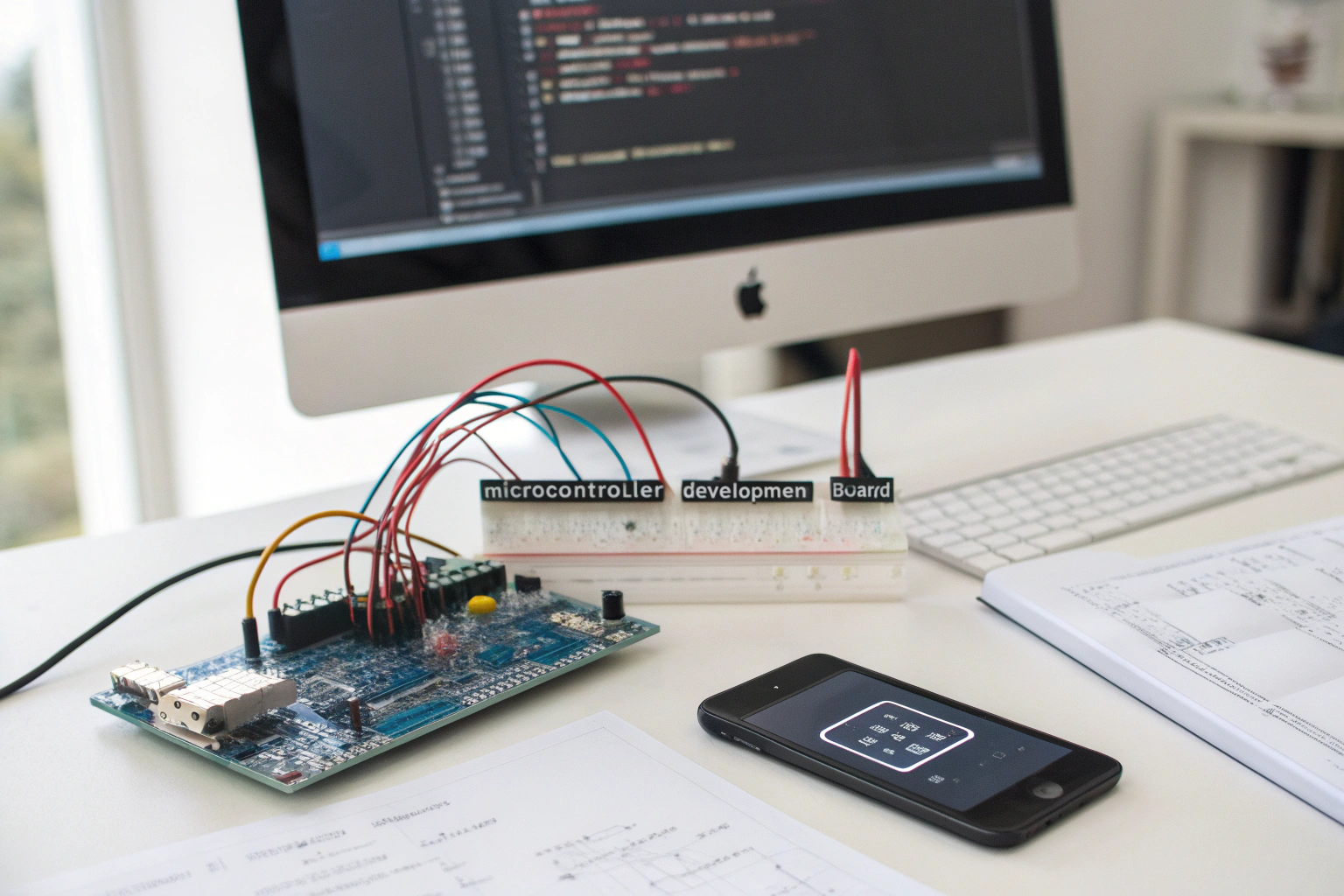
So, what does a firmware engineer do? A firmware engineer is a specialized software developer who creates the permanent software programmed into a device’s hardware, acting as the brain for electronic systems. This low-level code, written in languages like C or C++, allows the hardware to function and communicate with other software. It ensures devices from smart thermostats to medical equipment work reliably and efficiently from the moment they are powered on, directly impacting device performance, security, and battery life.
Key Benefits at a Glance
- Ensures Functionality: Makes sure hardware powers on and executes its core purpose, from a simple blinking light to complex data processing.
- Optimizes Performance: Writes highly efficient code to maximize hardware speed, minimize power consumption, and extend battery life in portable devices.
- Guarantees Reliability: Creates stable, bug-free software for mission-critical systems where failure is not an option, such as in cars or medical devices.
- Enables Connectivity: Develops the drivers and protocols that allow hardware components to communicate with each other, sensors, and the internet.
- Provides Updatability: Allows manufacturers to deploy secure updates to fix bugs, patch vulnerabilities, and add new features after a product is sold.
Purpose of this guide
This guide is designed for anyone exploring tech careers, from students to software developers considering a specialization, or simply those curious about how modern electronics work. It demystifies the role of a firmware engineer by breaking down their responsibilities into clear, understandable concepts. You will learn the key tasks, such as writing low-level code in C/C++, debugging hardware with specialized tools like oscilloscopes, and integrating software with physical components. Ultimately, this will help you grasp why this discipline is fundamental to the Internet of Things (IoT), consumer electronics, and advanced industrial systems.
Every time you use your smartphone to unlock it with your fingerprint, start your car with a push button, or adjust your smart thermostat, you’re interacting with the invisible work of a firmware engineer. These specialized professionals create the essential code that bridges the gap between computer hardware and the software applications we use daily. Unlike traditional software that runs on operating systems, firmware operates at the most fundamental level of embedded systems, directly controlling electronic components and ensuring devices function reliably.
The role of a firmware engineer has become increasingly critical as our world becomes more connected through the Internet of Things and smart devices. From medical devices that monitor patients’ vital signs to automotive systems that manage engine performance, firmware engineers are the architects behind the seamless operation of countless electronic products that define modern life.
- Firmware engineers bridge hardware and software by writing code that directly controls electronic devices
- Essential skills include C/C++ programming, hardware debugging, and understanding of embedded systems
- Career opportunities span automotive, IoT, medical devices, and consumer electronics industries
- Firmware engineering offers unique challenges with real-time constraints and hardware-level optimization
Defining firmware the bridge between hardware and software
Firmware represents a unique category of software that sits at the intersection of hardware and traditional applications. Unlike regular software that relies on an operating system to communicate with hardware components, firmware is stored directly in non-volatile memory such as flash memory or ROM, making it an integral part of the device itself. This persistent storage ensures that firmware remains available even when power is removed, allowing devices to boot up and function immediately upon activation.
The fundamental distinction between firmware and software lies in their level of abstraction and hardware dependency. While traditional software operates through multiple layers of abstraction provided by operating systems and frameworks, firmware works directly with hardware registers, memory addresses, and peripheral controllers. This direct hardware interaction requires firmware to be highly optimized for specific microcontrollers and processors, making it inherently platform-dependent.
In embedded systems, firmware serves as the foundation that enables all higher-level functionality. Consider a smart watch: the firmware manages the display controller, reads sensor data, handles wireless communication protocols, and coordinates power management—all while maintaining real-time responsiveness. For an overview of essential firmware concepts, consult Wikipedia.
The relationship between firmware and embedded systems is symbiotic. Embedded systems are specialized computing platforms designed for specific functions, ranging from simple microcontroller-based sensors to complex automotive control units. Firmware provides the intelligence that transforms these hardware platforms into functional devices, implementing the control algorithms, communication protocols, and user interfaces that define the system’s behavior.
Core responsibilities of a firmware engineer
A firmware engineer’s daily responsibilities span the entire development lifecycle of embedded systems, from initial hardware bring-up to long-term maintenance and optimization. These professionals must navigate the complex intersection of electrical engineering and software development, requiring both deep technical knowledge and practical problem-solving skills.
“Firmware engineers handle a range of tasks that are critical to the performance of hardware devices. Key responsibilities include: Design and develop firmware, debug and troubleshoot, collaborate with teams, test and validate firmware, update and maintain firmware, document firmware processes, ensure compliance, and optimize resource usage.”
— GeeksforGeeks, July 2025
Source link
The development process typically begins with analyzing hardware specifications and understanding the electrical characteristics of target microcontrollers and embedded systems. Firmware engineers must interpret schematic diagrams, datasheets, and timing requirements to create software that efficiently utilizes available resources while meeting performance constraints.
- Write low-level code that directly interfaces with hardware components
- Debug complex hardware-software integration issues using specialized tools
- Collaborate with hardware engineers to optimize system performance
- Develop and maintain device drivers for various peripherals
- Create technical documentation for firmware specifications and protocols
- Perform rigorous testing to ensure reliability in resource-constrained environments
Code optimization represents a critical aspect of firmware engineering, as embedded systems typically operate with severe memory and processing constraints. Engineers must implement efficient algorithms that minimize power consumption while maintaining real-time responsiveness. This often involves hand-optimizing critical code sections, managing memory allocation carefully, and implementing custom data structures tailored to specific hardware limitations.
Testing and validation in firmware development extends beyond traditional software testing methodologies. Engineers must verify functionality across various environmental conditions, validate timing-critical operations, and ensure electromagnetic compatibility. This comprehensive testing approach helps guarantee that devices will operate reliably throughout their intended lifespan, even in challenging operating conditions.
Essential skills and tools for firmware engineers
The firmware engineering discipline demands a unique combination of electrical engineering knowledge and advanced programming skills. Success in this field requires mastery of both theoretical concepts and practical tools that enable effective development and debugging of embedded systems.
“Firmware engineers typically need a bachelor’s degree or higher to qualify for their positions. They have specialized skill sets related to software and hardware development that take several years of studying to learn. A bachelor’s degree takes four years on average to complete, and those who wish to pursue firmware engineering often major in a subject like computer science, IT, engineering or another related field.”
— Indeed, June 2025
— Source link
Technical competency requirements extend beyond programming to include deep understanding of digital electronics, signal processing, and real-time system design. Firmware engineers must comprehend how software instructions translate to hardware operations, including memory management, interrupt handling, and peripheral communication protocols.
Programming languages and technical competencies
The choice of programming languages in firmware development is largely dictated by the need for direct hardware access and resource efficiency. C remains the dominant language due to its ability to provide low-level control while maintaining reasonable abstraction. The language’s explicit memory management and direct pointer manipulation capabilities make it ideal for embedded applications where every byte of memory and every processor cycle matters.
C++ finds application in more complex embedded systems where object-oriented design principles can improve code organization and maintainability. However, firmware engineers must carefully manage features like dynamic memory allocation and virtual functions, which can introduce unpredictable overhead in resource-constrained environments.
Assembly language programming becomes necessary when maximum performance is required or when implementing hardware-specific initialization routines. Modern microcontrollers often require assembly code for bootloaders, interrupt service routines, and timing-critical operations where precise control over instruction execution is essential.
| Language | Primary Use | Hardware Access | Learning Curve | Performance |
|---|---|---|---|---|
| C | System programming, device drivers | Direct memory access | Moderate | High |
| C++ | Complex embedded applications | Object-oriented hardware abstraction | Steep | High |
| Assembly | Critical timing, bootloaders | Complete hardware control | Very steep | Maximum |
| Rust | Safety-critical systems | Memory-safe low-level access | Steep | High |
| Python | Rapid prototyping, testing | Limited via libraries | Easy | Low |
Understanding microcontroller architectures forms the foundation of effective firmware development. Engineers must be familiar with different processor families, memory hierarchies, and peripheral interfaces. This knowledge enables them to make informed decisions about code structure, memory usage, and communication protocols that align with hardware capabilities.
Real-time systems knowledge becomes crucial when developing firmware for applications with strict timing requirements. Engineers must understand concepts like interrupt latency, task scheduling, and deterministic execution to ensure that critical operations complete within specified time constraints.
Debugging tools and techniques
Firmware debugging presents unique challenges that require specialized tools and methodologies. Unlike traditional software debugging that relies primarily on software-based debuggers and logging, firmware debugging often requires direct hardware analysis and real-time system monitoring.
Hardware debuggers such as JTAG and SWD interfaces provide essential capabilities for examining processor state, setting breakpoints, and stepping through code execution. These tools enable engineers to inspect register contents, memory values, and stack traces while the system is running, providing insights into system behavior that would be impossible to obtain through software-only methods.
Logic analyzers and oscilloscopes become indispensable when debugging communication protocols and timing-related issues. These instruments allow engineers to visualize digital signals, measure timing relationships, and verify that firmware-generated signals conform to protocol specifications.
- Reproduce the issue consistently in controlled environment
- Analyze system logs and error messages for initial clues
- Use hardware debuggers to examine register states and memory
- Apply logic analyzers to verify signal timing and protocols
- Isolate the problem by testing individual components
- Implement targeted fixes and verify resolution through testing
Advanced debugging techniques include boundary scan testing for complex PCB designs, power analysis for battery-operated devices, and electromagnetic interference testing to ensure regulatory compliance. These methodologies help identify issues that might not be apparent through traditional software debugging approaches.
The debugging process in firmware development is inherently iterative and often requires multiple tools working in combination. Engineers must develop systematic approaches to isolate problems, whether they originate from hardware issues, software bugs, or the complex interactions between firmware and physical components.
Firmware vs software engineering key differences
The distinction between firmware engineering and traditional software engineering extends far beyond the target platform, encompassing fundamental differences in development methodology, resource management, and system architecture. While both disciplines involve programming and system design, the constraints and requirements of each field create distinctly different professional practices.
Resource constraints represent perhaps the most significant difference between the two fields. Firmware engineers typically work with microcontrollers that have kilobytes of memory and operate at modest clock speeds, requiring every line of code to be optimized for space and performance. Software engineers, conversely, often have access to gigabytes of memory and powerful processors, allowing for more flexible design approaches and higher-level abstractions.
Hardware knowledge requirements create another major distinction. Firmware engineers must understand electrical engineering concepts including digital signal processing, power management, and electromagnetic compatibility. They need to interpret schematic diagrams, understand component specifications, and consider factors like power consumption and thermal management. Software engineers typically work at higher abstraction levels where hardware details are managed by operating systems and frameworks.
| Aspect | Firmware Engineering | Software Engineering |
|---|---|---|
| Hardware Knowledge | Deep understanding required | Minimal hardware awareness |
| Resource Constraints | Severe memory/power limits | Abundant system resources |
| Development Tools | Hardware debuggers, oscilloscopes | IDEs, profilers, simulators |
| Testing Environment | Physical hardware required | Virtual environments sufficient |
| Abstraction Level | Close to hardware | High-level abstractions |
| Real-time Requirements | Hard real-time constraints | Soft real-time acceptable |
| Platform Dependency | Highly platform-specific | Cross-platform compatibility |
Development environments also differ significantly between the two disciplines. Firmware development often requires specialized integrated development environments that support cross-compilation, hardware simulation, and real-time debugging capabilities. The development cycle typically involves frequent hardware testing and validation, as simulation environments may not accurately represent all aspects of the target system’s behavior.
Testing methodologies in firmware engineering must account for real-world operating conditions including temperature variations, power supply fluctuations, and electromagnetic interference. This comprehensive testing approach contrasts with software engineering where functionality can often be validated entirely through software-based testing frameworks and virtual environments.
The embedded software engineer role represents a middle ground between these two disciplines, combining elements of both firmware and software development. These professionals typically work on higher-level embedded systems that run operating systems like Linux, requiring knowledge of both hardware interfaces and traditional software development practices. The U.S. Bureau of Labor Statistics provides details on the career outlook for professionals in this field.
Career progression in firmware engineering often involves specialization in specific industries or technologies, such as automotive systems, medical devices, or wireless communication protocols. This specialization allows engineers to develop deep expertise in domain-specific requirements while building valuable professional networks within their chosen industry sectors.
Frequently Asked Questions
A firmware engineer develops and maintains the low-level software that controls hardware devices, ensuring seamless interaction between software and hardware components. They work on embedded systems, debugging code and optimizing performance for devices like microcontrollers and IoT gadgets. This role requires a deep understanding of both hardware and software to create reliable and efficient systems.
The role of a firmware engineer involves designing, coding, and testing firmware for electronic devices, bridging the gap between hardware and higher-level software. They collaborate with hardware engineers to integrate firmware into systems and ensure functionality under various conditions. Additionally, they may handle updates, security implementations, and performance enhancements to meet product specifications.
Firmware engineers need strong programming skills in languages like C and C++, along with knowledge of hardware interfaces and real-time operating systems. Requirements often include a degree in computer engineering or a related field, experience with debugging tools, and an understanding of electronics. Soft skills such as problem-solving and teamwork are also essential for successful project collaboration.
Essential programming languages for firmware engineers include C and C++, which are widely used for their efficiency in low-level system programming. Assembly language is also important for optimizing code in resource-constrained environments. Other languages like Python may be used for scripting and testing, but C remains the cornerstone for most firmware development tasks.
A firmware engineer focuses specifically on writing and maintaining the software that runs directly on hardware, often dealing with bootloaders and device drivers. In contrast, an embedded engineer has a broader scope, including hardware design, system architecture, and integration of both software and hardware components. While there is overlap, firmware engineering is more software-oriented within the embedded systems domain.

Hi, I’m Liam Hamilton — a tech enthusiast and developer with years of hands-on programming experience. This blog is my space to share practical advice, explore the latest trends in the IT world, and break down complex tech concepts into simple, understandable insights. I believe technology should be accessible to everyone who wants to stay ahead in the digital era.